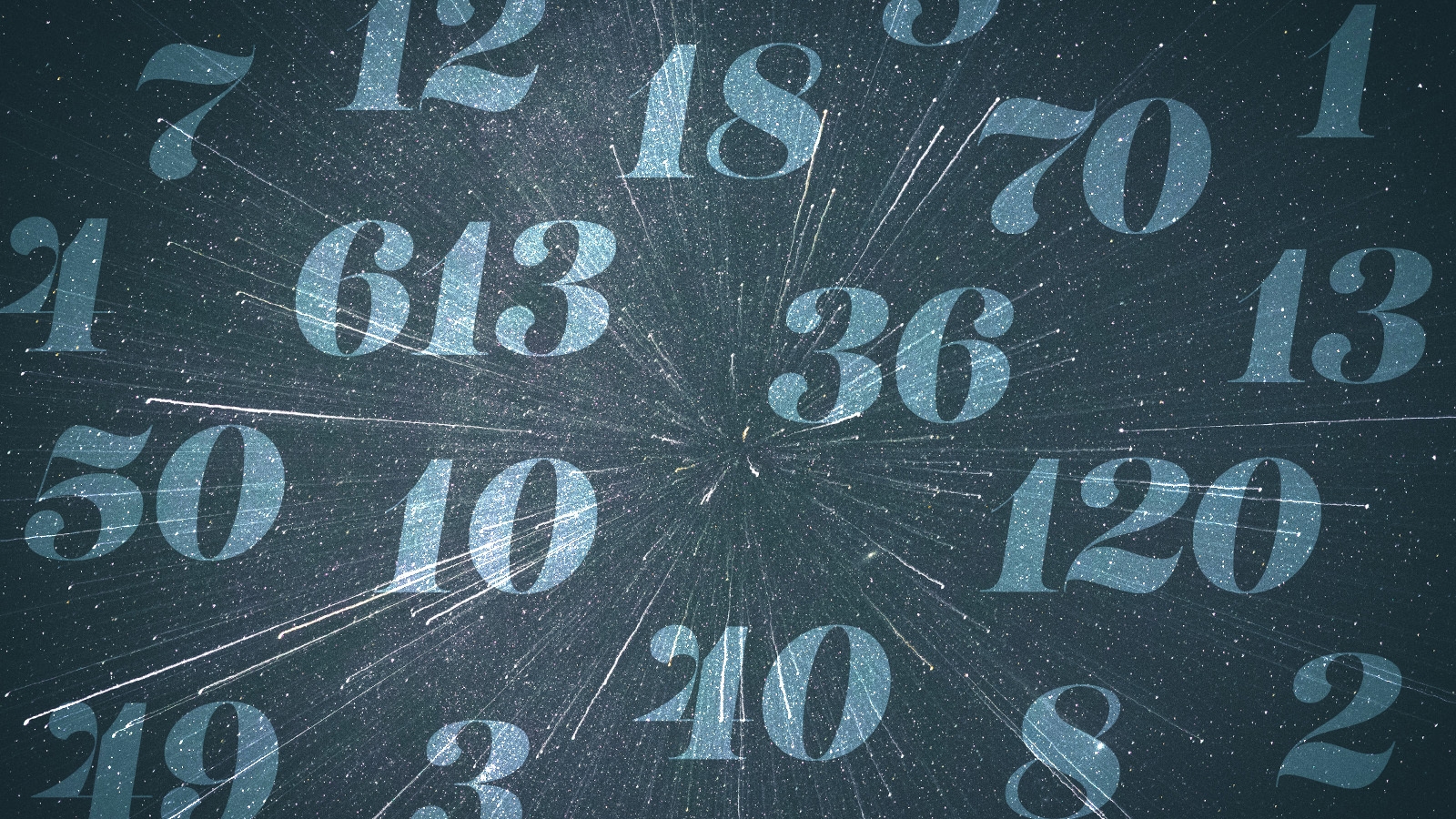
Jews have always enjoyed finding meaning and significance in special numbers, perhaps most intensively through the practice of gematria, ascribing numerical values to letters and words that are said to reveal mystical connections. But even beyond this esoteric practice, certain numbers have a way of reappearing in the tradition, and have accrued significance by virtue of their presence in key texts and rituals.
There is even a song sung toward the close of the Passover seder, Echad Mi Yodeya (Who Knows One?), that catalogs the significance of the numbers one through 13 in the tradition. But there are many numbers beyond those that have been meaningful to Jews. Here is a look at some favorites:
One
Unlike many other religions, especially in ancient times, a hallmark of Judaism is monotheism — belief in one God. It is this belief that the universe was created and is governed by a singular, benevolent deity that undergirds the Jewish view that the universe is ordered and purposeful. The closest thing Judaism has to a declaration of faith, the Shema, which is recited twice daily, declares: Hear O Israel, the Lord is our God, the Lord is one.
Two
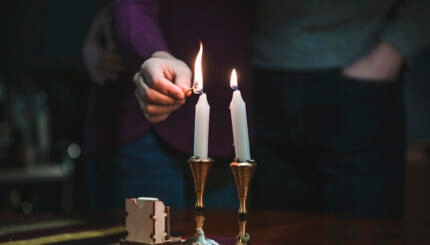
Pairs appear and reappear in various Jewish contexts, from the animals that entered Noah’s ark two-by-two to the two tablets of the Ten Commandments. It is traditional to light two candles at the start of Shabbat and other Jewish holidays, and two place two challahs on the table.
With your help, My Jewish Learning can provide endless opportunities for learning, connection and discovery.
Three
Judaism began as a family religion, practiced by three generations of fathers and sons (and their families) known as the patriarchs: Abraham, Isaac and Jacob. The Amidah, the central Jewish prayer, addresses the Jewish God as the God of these three.
In addition, the Jewish festival calendar is governed by three pilgrimage festivals — Passover, Shavuot and Sukkot — that reenact the primal Jewish history, starting with the exodus from Egypt and continuing with the revelation at Sinai and finally the journey through the wilderness that would lead the people to the promised land.
The Shema, the daily Jewish prayer, is surrounded by three blessings that outline cosmic history as unfolding in three movements, starting with the creation of the world, followed by revelation at Sinai, and finally ending with the redemption that will bring about the messianic era.
In some communities, a child receives their first haircut at age three in a ceremony known as an upsherin.
Finally, the Jewish people are classically divided into three groups: priests (kohanim), Levites and Israelites. In many synagogues, the aliyot in the Torah service are reserved for members of these groups, with priests taking the first aliyah, Levites the second, and Israelites the remaining aliyot. Some say that the three matzahs on the Passover table represent these three groups in Israel.
Four
While Judaism has three patriarchs, it has four matriarchs, or mothers: Sarah, Rebecca, Rachel and Leah.
The Passover seder is famously replete with fours, from the four cups of wine that structure the evening to the Four Questions and the Four Sons.
Four is also a number classically seen as describing the basic shape of the world, from the four rivers that flowed from the primordial Garden of Eden to the four winds that blow in each of the cardinal directions. Heaven and earth are also described, in ancient Jewish texts, as each having four corners.
Finally, Jewish garments with tzitzit (ritual fringe), including the tallit (worn over clothes) and the tallit katan (worn under clothes), always have four corners with the special fringes.
Five
The Torah, Judaism’s central sacred texts, is divided into five books, sometimes called the Chumash (from the Hebrew word for five) or the Five Books of Moses.

On a tallit, a Jewish ritual prayer shawl, each of the tzitzit, the special corner tassels, is composed of fringes that are knotted with five double knots each, which separate four wound sections. In Ashkenazi tradition, the five knots separate sections with seven, eight, 11 and 13 winds each. And in Sephardic tradition, the knots separate sections of 10, five, six and five winds each, with each of those numbers corresponding to a letter in God’s personal name, the tetragrammaton.
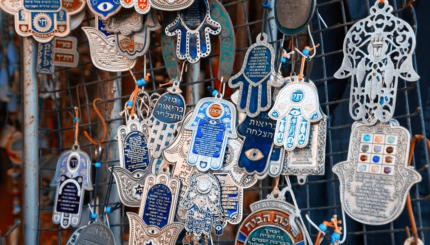
Finally, the word hamsa, a popular Jewish talisman that is shaped like a hand, is related to the Hebrew word for five, because the hand has five fingers.
Seven
Seven is perhaps one of the most significant numbers in Judaism. The Jewish week is seven days long, because God created the world in six days and rested on the seventh. (The Hebrew word for week, shavua, is derived from the Hebrew word for seven, sheva.) The menorah in the ancient Temple also represented the creation with seven branches, three on each side and one in the middle. (The Hanukkah menorah, with nine branches, is modeled on it.)
The number seven doesn’t just structure the daily cycle of Jewish life, it is also part of a Jewish yearly agricultural cycle. Every seventh year, called the shmita or sabbatical year, the land is not tilled but allowed to lie fallow and rest.
According to Jewish tradition, there are 613 commandments that Jews must follow, but just seven for the rest of humanity. These are called the seven Noahide laws.
At Jewish weddings, seven blessings (Sheva Brachot) are recited over the bride and groom under the huppah. In some cases, the bride circles the groom seven times, and in other contexts the couple circles one another seven times.
An ancient Jewish midrash notes the significance of the number seven in Judaism, and lists a few more instances:
All the sevenths are always beloved. Above the seventh is beloved (there are seven names for heaven): Skies, skies of the skies, firmament, heavens, celestial realm, abode, and clouds … In the lands, the seventh is beloved (there are seven names for earth): Earth, ground, globe, valley, wilderness, oblivion and world … In the generations, the seventh is beloved: Adam, Shet, Enosh, Keinan, Mahalalel, Yered and Chanoch (seven generations separated Adam, the first person, from Enoch, the first person who didn’t die). In the forefathers, the seventh is beloved: Abraham, Isaac, Jacob, Levi, Kehat, Amram and Moshe (seven generations separated Abraham from Moses) … In sons, the seventh is beloved, as it is stated (I Chronicles 2:15), “David was the seventh.” (The great King David was the seventh son in his family.) … In years, the seventh is beloved, as it is stated (Exodus 23.11), “But in the seventh you shall let it rest and lie fallow.” In sabbatical years, the seventh is beloved, as it is stated (Leviticus 25:10), “And you shall sanctify the fiftieth year.” In days, the seventh is beloved, as it is stated (Genesis 2:3), “And God blessed the seventh day.” In months, the seventh is beloved, as it is stated (Leviticus 23:24), “In the seventh month on the first day.” (Rosh Hashanah takes place in the seventh month, according to the biblical ordering of months.)
— Leviticus Rabbah 29:11
Eight
Jewish boys are circumcised on the eighth day of life.
Ten
Ten commandments were given at Sinai. In addition, ten adult Jews are required to make a minyan, a prayer quorum that is needed to recite certain prayers. And in Jewish mystical tradition, there are ten sefirot or emanations of God.
Twelve
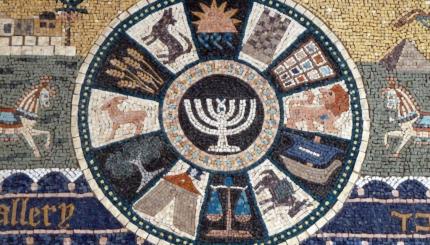
Ancient Israel was divided into 12 tribes, corresponding to the 12 sons of the third patriarch Jacob, which were represented by 12 stones on the high priest’s breastplate. Likewise, the year is divided into 12 months (when it is a non-leap year), each day and night are divided into 12 hours, and there are 12 houses of the zodiac.
Thirteen
Jewish tradition holds that God has 13 attributes of mercy, which are recited during Selichot and High Holiday prayers. The Jewish sage Maimonides also held that there were thirteen articles of Jewish faith, which are codified in a prayer popularly used to close Friday night services, Yigdal.
According to Jewish tradition, a boy comes of age, meaning he is responsible for all of the mitzvot, when he turns 13 and becomes a Bar Mitzvah. In some communities, girls also come of age at 13, though in others it is at age 12.
Eighteen
Gematria is the Jewish practice of assigning a numerical value to each letter and then adding up the value of certain words. Perhaps the most famous example is that the numerical value of the word chai, which means life, is 18. Eighteen is therefore considered a lucky Jewish number and Jews often give monetary gifts in multiples of eighteen (e.g. $18 or $180).
In addition, the central Jewish prayer, the Amidah, is known as the Shemonah Esreh, literally “the Eighteen” because it was originally composed of 18 blessings. Today, it has 19 blessings, but it is still called the Shemonah Esreh.
Thirty-six
There is a Hasidic idea that every generation of humanity has 36 righteous people who sustain the whole world, though their identities are unknown. It is on account of their extraordinary goodness and piety that the world is not destroyed. These 36 are called the tzadikim nistarim (literally: hidden righteous ones) or the lamed vavniks (from the Hebrew letters lamed and vav whose value adds up to 36).
Forty
Forty appears frequently in the Hebrew Bible, usually as a significant span of time during which a radical transformation is wrought. In the story of Noah’s ark, God causes the heavens to rain for 40 days and nights. In order to receive the Torah, Moses spends 40 days on Mount Sinai. And the Israelites are punished with wandering in the wilderness for 40 years until the entire generation that was liberated from Egypt passes away and a new generation is ready to enter the promised land.
Forty-Nine/Fifty
Just as seven has great significance in Judaism, so does the number seven times seven. Between Passover and Shavuot, Jews count seven times seven weeks, or 49 days, a period referred to as the Omer. The next day, the 50th, is Shavuot.
Similarly, according to the ancient Jewish agricultural calendar, every seventh year the land was granted a shmita (sabbatical year) during which it was not cultivated and allowed to rest. After each seven cycles of shmita, in the 50th year, the Israelites would celebrate the yovel (Jubilee) year. During this year, not only was the land permitted to rest, but slaves were freed, debts were forgiven and land was returned to its original owners. The practice was meant as a societal reset.
Seventy
According to Jewish tradition, there are 70 nations and 70 languages in the world. Thus, 70 in some way represents the totality of the world. The Sanhedrin, the highest ancient Jewish court, was made up of 70 sages. Seventy is also considered the full span of a human life, and was the number of years granted to King David.
One Hundred and Twenty
While 70 years is considered a full lifespan, Jewish tradition holds that 120 is the oldest age a person can reasonably hope to achieve. It is the age Moses was when he died, and it is common, on birthdays, for Jews to wish one another “ad me’ah v’esrim” — to 120 years old!
READ: 120 Jewish books to read in your lifetime, from ages 1 through 120
Six Hundred and Thirteen
According to ancient rabbinic tradition, the Torah contains 613 mitzvot, or commandments. The medieval scholar Maimonides listed all 613 and noted that these include 365 negative commandments (things one may not do) which correspond to the 365 days in the solar year, and 248 positive commandments (which one should do) that correspond to the number of parts in the human body. There is a Jewish tradition that pomegranates have 613 seeds, corresponding to the mitzvot.
Hanukkah
Pronounced: KHAH-nuh-kah, also ha-new-KAH, an eight-day festival commemorating the Maccabees' victory over the Greeks and subsequent rededication of the temple. Falls in the Hebrew month of Kislev, which usually corresponds with December.
menorah
Pronounced: muh-NOHR-uh, Origin: Hebrew, a lamp or candelabra, often used to refer to the Hanukkah menorah, or Hanukkiah.
Sukkot
Pronounced: sue-KOTE, or SOOH-kuss (oo as in book), Origin: Hebrew, a harvest festival in which Jews eat inside temporary huts, falls in the Jewish month of Tishrei, which usually coincides with September or October.
Talmud
Pronounced: TALL-mud, Origin: Hebrew, the set of teachings and commentaries on the Torah that form the basis for Jewish law. Comprised of the Mishnah and the Gemara, it contains the opinions of thousands of rabbis from different periods in Jewish history.
Torah
Pronunced: TORE-uh, Origin: Hebrew, the Five Books of Moses.