Two of the four mitzvot that are traditionally fulfilled during Purim involve food: giving out mishloah manot (gifts of food), and enjoying a festive meal in the afternoon known as the Seudat Purim. There are several foods that are often associated with Purim celebrations — and many of them are designed to lampoon the story’s infamous villain, Haman.
Hamantaschen
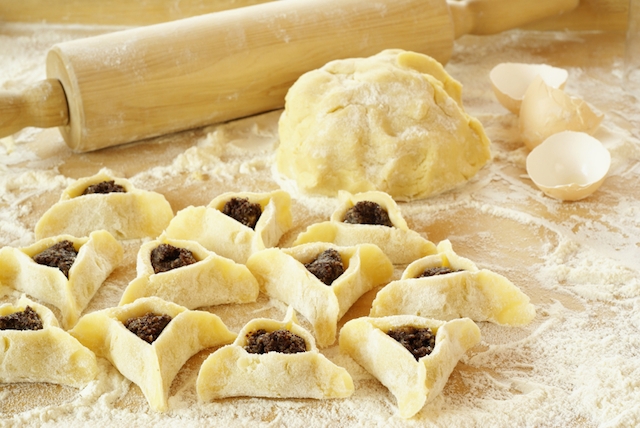
Hamantaschen (Yiddish for “Haman’s pockets”) are the most famous Purim food. These triangular cookies are often filled with poppy seed, chocolate, jelly or other sweet flavors. Known as oznei haman (Haman’s ears) in Hebrew, hamantaschen are commonly included in mishloach manot or served as a snack at Purim parties.
The tradition of eating hamantaschen on Purim began in late 18th-century Germany when pastries filled with poppy seeds were a popular treat. These cookies were called “mohntaschen” which translates to “poppy seed pockets.” In the early 19th century, German Jews started making them specifically for Purim and called them “hamantaschen” because the name of the Purim villain, Haman, sounds like “mohn.” Playing off the pun, it was said that the cookies stuffed with seeds represented Haman’s pockets stuffed with bribes.
Hamantaschen can be a tricky cookie to master. Learn how to make the perfect hamantaschen here.
With your help, My Jewish Learning can provide endless opportunities for learning, connection and discovery.
More Purim Cookies
The sweets that are enjoyed by Jews during Purim aren’t limited to hamantaschen. Hadgi badah, an almond/cardamom cookie, are popular among Iraqi Jews, while ma’amoul stuffed with pistachios, dates or walnuts are often enjoyed by Jews from Lebanon, Egypt, Syria and other Arab countries (this cookie goes by other names, including kadeh for Kurdish Jews and kleicha for Iraqi Jews). In North Africa, Jewish communities celebrate Purim with debla: Strips of thin dough wrapped into the shape of a rose and deep-fried until golden, then soaked in a sugar syrup and covered in crushed nuts. The rolled shape symbolizes the megillah.
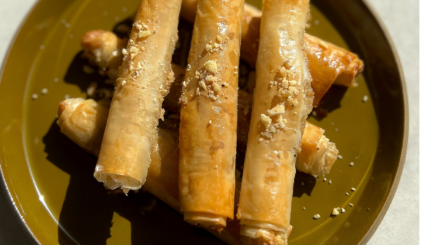
Like hamantaschen, other Purim cookies evoke Haman’s demise, like Haman’s Fingers, which are common among Sephardic Jews from Greece and Turkey. Phyllo dough is filled with chopped almonds and cinnamon, then rolled into a finger shape before being brushed with margarine and baked. In France, Jews enjoy palmiers, which are said to resemble Haman’s ears.
Kreplach
Before enjoying triangular cookies, many Ashkenazi Jews eat the stuffed triangle soup dumplings that are commonly known as kreplach. While kreplach is traditionally stuffed with meat, vegetarians can opt for a mushroom filling.
Learn how to make both meaty and meatless kreplach here.
Kulich/Keylitsch
In Russian Jewish communities, a special sweet challah accompanies the Purim meal. Unlike the challah that you’ll find at a Shabbat meal, this Purim challah — known as kulich or keylitsch — is so much sweeter that it’s practically cake. This challah is sometimes filled with raisins or candies to make it even sweeter. Unlike its Shabbat counterpart, kulich is made using longer strands, which symbolize the ropes that Haman intended to hang Mordechai with, but were ultimately used to hang Haman at the end of the Megillah instead.
In some communities, challah also makes an appearance during the Purim meal, but it is crown-shaped, and the strands are filled with poppy seeds before baking. Learn how to make it here.
Boyoja Ungola
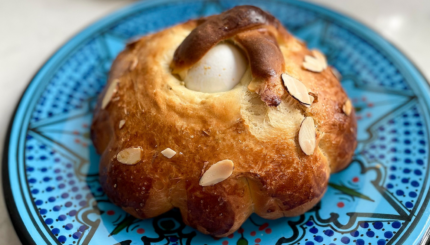
Also known as Ojos de Haman, Spanish for “Haman’s eyes,” this round bread is enjoyed during Purim by Moroccan Jews. Two hard-boiled eggs are placed in the middle of the bread, and then strips of pastry dough are placed over the eggs to form an X. The bread is baked, and before being eaten, the egg “eyes” are ripped out first.
Stuffed Cabbage
While some Jews associate stuffed cabbage with Simchat Torah or Passover, stuffed cabbage is a traditional entree for Seudat Purim among Jews hailing from Lithuania, Poland and Hungary. Some say the stuffing represents the hidden miracles performed by God during the Purim story.
Anything Poppy Seed
Poppy seeds can be found in plenty of dishes on Purim menus, from rolled cookies in Israel to classic Hungarian pasta dishes. Some say consuming poppy seeds during Purim honors Esther, who is said to have eaten only poppy seeds during her three-day fast. Others trace the culinary custom to the word for poppy seed in German and Yiddish, mohn, being similar to the name Haman. Persian Jewish communities also utilize poppy seeds, especially in nan-e berenji, a small shortbread cookie topped with the black seeds in the middle to symbolize Haman’s fleas.
Nuts and Legumes
At a Purim meal, it’s common to find appetizers, snacks and side-dishes that incorporate chickpeas, beans, lentils and a variety of nuts. These dishes honor the legend that Esther did not have access to kosher food while living in the palace and lived entirely on nuts, seeds and legumes so she would not violate the laws of kashrut. Fassoulyeh b’chuderah, a Syrian bean and tomato stew spiced with cinnamon, is one of the many dishes that honor this custom.
Purim Recipes from My Jewish Learning and The Nosher
Sweet Hamantaschen
Chocolate and Sprinkles Dipped Hamantaschen
Rosewater and Pistachio Hamantaschen
Rice Krispies Treats Hamantaschen
Coconut Cheesecake Hamantaschen
Chocolate Hamantaschen With Irish Creme Filling
Savory Hamantaschen
Three-Ingredient Pizza Hamantaschen
Pretzel Bagel Dog Hamantaschen
Rosemary Hamantaschen with Balsamic Caramelized Jam
More Purim recipes
Cocido (Spanish Chickpea Stew)
Purim
Pronounced: PUR-im, the Feast of Lots, Origin: Hebrew, a joyous holiday that recounts the saving of the Jews from a threatened massacre during the Persian period.
Sephardic
Pronounced: seh-FAR-dik, Origin: Hebrew, describing Jews descending from the Jews of Spain.
Yom Kippur
Pronounced: yohm KIPP-er, also yohm kee-PORE, Origin: Hebrew, The Day of Atonement, the holiest day on the Jewish calendar and, with Rosh Hashanah, one of the High Holidays.