The main preparation for Yom Kippur is to keep in mind what the day is about–teshuvah. We should approach Yom Kippur as the end of a long process of introspection leading to change. We should have already begun a turning away from our old ways and a turning toward God, a turning toward the other people in our lives, and, most important, a turning toward our true selves. Amid the imagery of doom, judgment, and sin, it is important to remember that Yom Kippur is not just a turning away from the negative. It is a positive turning as well. This process should have begun in Elul [the month preceding Rosh Hashanah] and continued at a faster pace through Rosh Hashanah and the ten days of repentance. Yom Kippur’s purpose is to give us a sense that time is runningout. Yom Kippur stands at the end of the race, urging us on to make ever greater efforts to cross the finish line before either time or our strength (commitment) runs out.

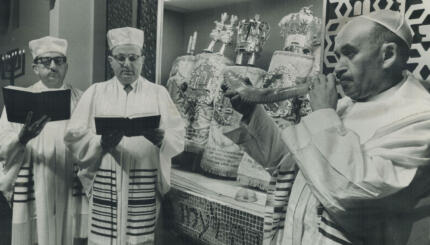
As such, some people have found it useful to see the Yom Kippur experience as a brush with our own mortality–with death. Hence we wear a white kittel, a robe that will serve as our shroud one day, and we abstain from the routine physical activities that keep us alive–eating and drinking. On this day we confront that which we spend most of our lives denying–that we shall die and be no more. Yom Kippur awakens us to lead our lives more fully because we come face-to-face with and thus must acknowledge our mortality.
Another image of Yom Kippur is that of making a journey, an experience we share with our fellow travelers–that is, the others we will be praying with during the next twenty-four hours. Some people like to begin this journey through time, if not space, with a prayer for a successful journey, adapted from the prayer traditionally recited before making long journeys:
With your help, My Jewish Learning can provide endless opportunities for learning, connection and discovery.
May it be Your will, Lord our God and God of our ancestors, to lead us in safety and to direct our steps in safety, to guide us to our desired destination in joy and peace and to bring us home in peace. Save us from all dangers and accidents, and from all afflictions that threaten our world. May You and all who we may meet look upon us with kindness, favor and mercy. Listen to out plea for You are God who hears prayers and pleas. Praised are You, 0 Lord, who listens to prayer. [The Hebrew text can be found in a traditional prayer book.]
Each of us will engage in this process in ways best suited for us. Since on Yom Kippur we do not atone for sins between us and our fellow humans, we should try to obtain forgiveness before the holiday from all those we have hurt in the past year. This process of reconciliation has found a ritual form in a prayer that recently some havurot [informal pray and study groups]have begun to recite at the end of the Kol Nidrei service. (A Hebrew version can be found on p. 350 of Machzor for Rosh ha-Shanah and Yom Kippur, edited by Jules Harlow, New Rabbinical Assembly, 1972.)
I hereby forgive all who have hurt me, all who have done me wrong, who deliberately or by accident, whether by word or by deed. May no one be punished on my account. As I forgive and pardon fully those who have done me wrong, may those whom I have harmed forgive and pardon me, whether I acted deliberately or by accident, whether by word or deed. I am now ready to fulfill the commandment of “to love my neighbor as myself.”
Each person remains seated until he or she feels ready to recite the above, then quietly leaves the room. Whether placed in a ritual context or not, the mitzvah [commandment] of loving your neighbor must be confronted on this day.
Reprinted with permission from The Jewish Holidays: A Guide and Commentary (HarperCollins Publishers Inc.).
Elul
Pronounced: eh-LULE, Origin: Hebrew, Jewish month usually coinciding with August-September.
mitzvah
Pronounced: MITZ-vuh or meetz-VAH, Origin: Hebrew, commandment, also used to mean good deed.
Rosh Hashanah
Pronounced: roshe hah-SHAH-nah, also roshe ha-shah-NAH, Origin: Hebrew, the Jewish new year.
Yom Kippur
Pronounced: yohm KIPP-er, also yohm kee-PORE, Origin: Hebrew, The Day of Atonement, the holiest day on the Jewish calendar and, with Rosh Hashanah, one of the High Holidays.