Herring and Onions
A stinky fish with a fervent following.
Written with Efim and Irina Marmer.
Among the classic Ashkenazic foods, none evokes as much love and repulsion, none is as intensely linked to the Old World, as herring–a salty fish with a distinct smell. This aroma is only exacerbated by the typical method of serving herring: pickled, with marinated onions. Yet, if you have ever seen the old men in shul, with a shot of whiskey in one hand, and a piece of herring in the other, if you have ever seen the pure bliss on their faces, you may have been tempted to sample and explore the object of their admiration.As Rabbi Noah Bickhart noted to me, of course there’s nothing intrinsically Jewish about eating herring–the fish is as popular in Scandinavia as it is throughout Eastern Europe. For that matter, noted the rabbi, there’s nothing particular Jewish about whiskey either–but the combination, in shul–that’s very Jewish.
Most likely, the fish became popular among Eastern European Jews for practical reasons: it was cheap. Rather than calling herring by its Russian moniker, seledka, my great-grandmother Riva called it oseledka, adding a slight “oh” in the beginning of the word as a breathy sigh of pure adoration. Indeed, she, like many other shtetl balabustes knew how to make a whole feast out of a single herring.
Today, on this side of the ocean, not a whole lot of people know (or want to know) that herring can actually be bought whole, and prepared in a number of ways. Be a mentch, try the recipe you find below. You might even like it.
Before the recipe though, a quick word on the variety of cured, store-bought herring, by means of a Woody Allen quip:
A man who could not marry off his ugly daughter visited Rabbi Shimmel of Cracow. “My heart is heavy,” he told the Rev, “because God has given me an ugly daughter.”
“How ugly?” the Seer asked.
“If she were lying on a plate with a herring, you wouldn’t be able to tell the difference.”
The Seer of Cracow thought for a long time and finally asked, “What kind of herring?”
The man, taken aback by the query, thought quickly and said, “Er–Bismarck.”
“Too bad,” the Rabbi said. “If it was Maatjes, she’d have a better chance.”
Woody Allen, Getting Even
You may think Woody is jesting, and there’s really no difference between Bismarck and Maatjes herring, but the distinction is crucial. Bismarck is the salted fillet and roe of herring, pickled in vinegar, white wine, and spices. Maatjes (or soused) herring is baked or fried in a marinade containing vinegar, spices, tea, sugar, herbs and served therein. Can you compare the fine, gentle Maatjes that melts on your tongue with pungent, raw Bismarck? You may also encounter the Shmaltz herring, which is the fatty, mature hunks of fish, preserved in the mixture of vinegar, spice, and schmaltz–chicken or goose fat.
When buying herring for the recipe below, I recommend getting a simple non-cured whole fish, most often found at a Russian specialty shop. These herring are stored in a mixture of water and salt, so they are already semi-pickled.
For other herring variations, try these recipes for forshmak and herring in an overcoat.
Ingredients
1 tablespoon vinegar (any kind)
4 tablespoons vegetable oil
1 small onion
1 herring (for starters)
Directions
Wash the fish thoroughly, and dispose of all of the innards and the head. Cut the fish along the spine, and gently, with your fingers, pull the fillet off the bones.
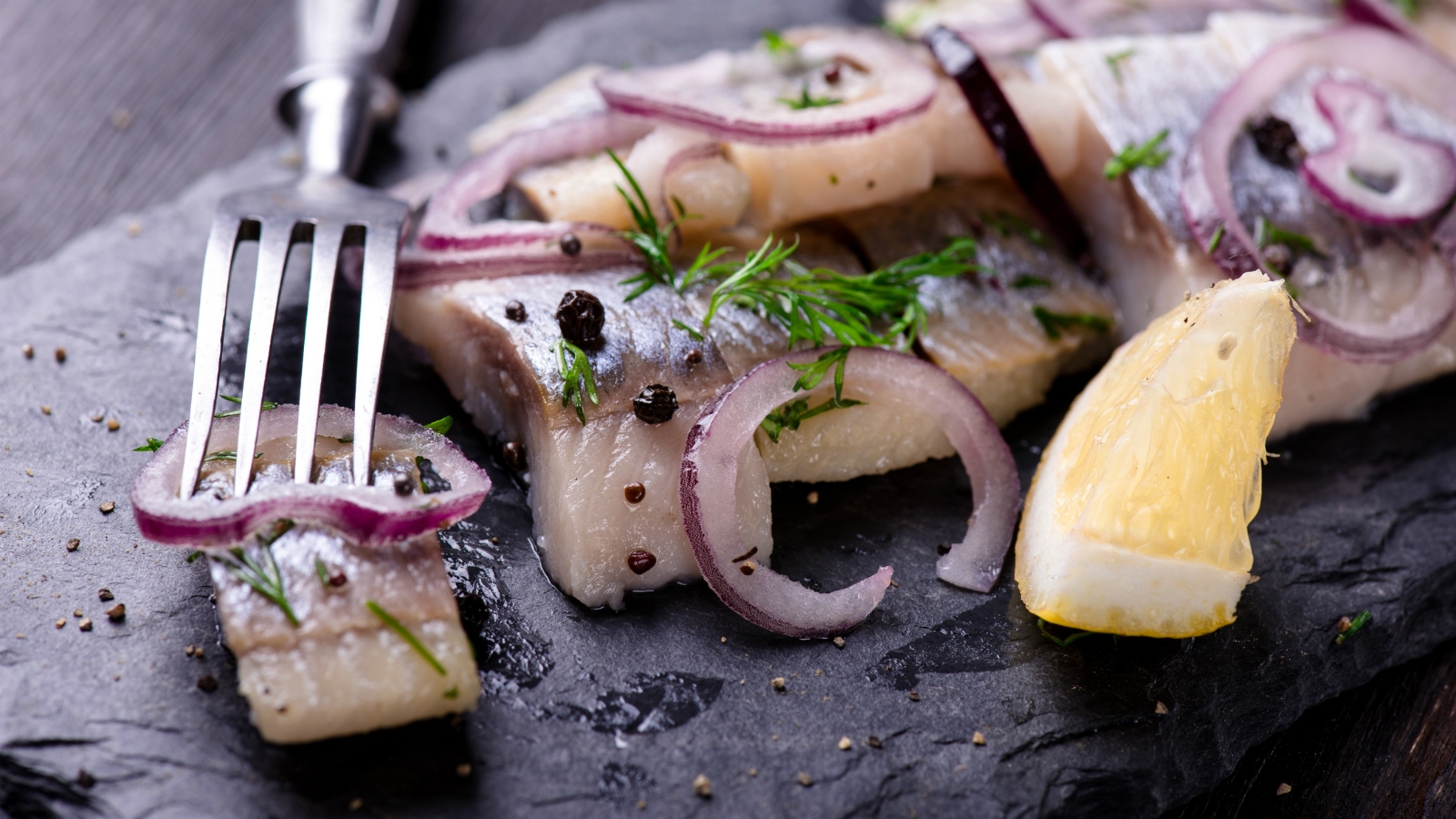
Slice the onion into thin rings and lay them beneath and over the herring. Mix the oil with the vinegar and marinade the onion and fish mixture in it for a few hours.
Cut the fillet diagonally, and arrange the pieces, in the shape of a fish, on a plate, with onion rings atop. Pour the marinade over it and keep refrigerated.