The Sefirot

According to the kabbalists, the attributes of God relate to each other in a scripted way.

  • Bookmark and Share
  • The medieval kabbalists believed that God's self could not be understood, but God has revealed attributes that interact with each other and the world. These are known as sefirot. Just as human beings are made up of various internal traits or tendencies of personality, all of which interact with one another, so too God is made up of various internal traits or "drives." The imagery used to describe the sefirot and their relationships is often visual and physical, even sexual. Light and the lack of light is also an important concept in discussions about the sefirot; light is used to symbolize (among other things) proximity to the divine. The sefirot are ascribed colors--functions of light--that symbolize their place within the divine realm. In the Zohar, the greatest kabbalistic work, the Torah is interpreted in reference to the sefirot. The symbolic framework mentioned above and detailed below is used in this interpretative process.

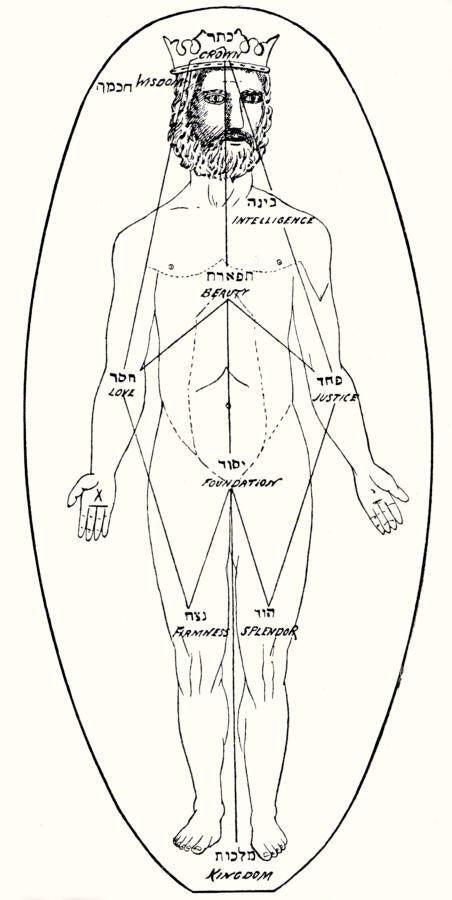
    The following article is reprinted with permission from Essential Judaism. The picture of the sefirot is reprinted with the permission of Eliezer Siegel.

    There are 10 sefirot, linked in a complex figure that some have called the "Tree of Life," significantly a phrase also often used to refer to the Torah. They are Keter (Crown), Hokhmah (Wisdom), Binah (Understanding), Hesed (Lovingkindness), Gevurah (Might) or Din (Judgment), Tiferet (Beauty), Hod (Splendor), Netzah (Victory), Yesod (Foundation), and Malkhut (Sovereignty) or Shekhinah (the Divine Presence). Each of them represents one aspect of the Godhead, a facet of the powers of the All Powerful. Each is also identified with a part of the body or aspects of the human personality, a color, and one of the Names of the Holy One.

    The relationship of the sefirot looks something like this:

    As you can see from the diagram, the attributes of God are highly interdependent, with each one linked to several others. (According to the kabbalists of Safed, each of the ten sefirot contains within it all of the others [i.e., each sefirah represents a piece of a totality and contains an image of this totality within itself].) By understanding their interrelationship, we can understand in some small way the process of The Creation itself.

    The name of God associated with Keter is "Ehyeh,"which is what God says when Moses asks who speaks from the burning bush: "Ehyeh asher ehyeh (I will be what I will be)." In some kabbalistic texts, this sefirah is associated with the point at the tip of the letter yod in the Tetragrammaton (the four‑letter name of God which is never spoken, but which is spelled yud‑hey‑vav‑hey in Hebrew). The body part associated with Keter is "aura," the space directly above the head; Keter has no color.

    The name of God associated with Hokhmah is Yah or the yod in the Tetragrammaton. The body part associated with Hokhmah is the right hemisphere of the brain. Hokhmah's color is blue.

    Binah is associated with the letter hey in the Tetragrammaton and with the name of God Elohim.In the body, Binah is usually associated with either the left hemisphere of the brain or the forehead. Binah's color is green.

    Hesed is associated with the Divine name El or El Elyon (Supreme God). It corresponds to the right arm. Hesed's color is white.

    Gevurah is associated with Elohim as the name of God. It corresponds to the left arm. Gevurah's color is red.

    Often associated with the Written Torah (Tanakh), Tiferet corresponds to the Tetragrammaton itself; in some systems, it is associated with the vav of the Tetragrammaton. The torso is the body part that corresponds to Tiferet. Tiferet's color is purple.

    Netzah and Hod are associated with the Divine names YHVH Tsva'ot (Lord of Hosts)and Elohim Tsva'ot (God of Hosts), respectively. Netzah corresponds to the right leg, Hod the left, but they are also often linked to the left and right kidneys (sources of advice in talmudic lore), the testicles, or the female breasts (sources of fertility and nurturing sustenance, respectively). Netzah's color is light pink, Hod's dark pink.

    Yesod is associated with the phallus and is, therefore, closely linked with the mitzvah of circumcision. Yesod's color is orange, and the names of God it corresponds to are El Hai (The Living God), El Shaddai (God Almighty), and the point at the bottom tip of the vav in the Tetragrammaton.

    In some kabbalistic systems, Malkhut corresponds to the feet but in others it is said to be associated with the mouth. Malkhut is associated with the name Adonai (Our Lord) or the final hey of the Tetragrammaton. Malkhut's colors are blue and black.

    As you can see from the diagram and the description of the sefirot, the left side of the "tree" corresponds to attributes of power and justice, the attributes that characterize Gevurah. This is seen by the kabbalists as the feminine side of God, representing the fear and awe of God, the principles of separation and distinction. By contrast, the right side, the masculine side, represents qualities of unity, harmony, and benevolence, the attributes that characterize Hesed. But the world can only survive if it is founded on a balance between the two.

    It is in the search for that balance that the human role in Creation comes into play. The sefirot have a purpose and we are an integral part of that purpose. Our behavior in the lower world, our world, affects the upper world (or worlds, as Luria's followers would have it) of the Divinity. Only when the ideal balance of justice and mercy, of God's transcendent and immanent qualities, is achieved can there be peace and fulfillment. And that, the kabbalists teach, can only be brought about through human actions, through self‑mastery, through prayer and meditation and the fulfillment of the mitzvot. Thus, the kabbalistic idea comes back to the basic teachings of the sacred texts.

    From Essential Judaism by George Robinson. Copyright (c) 2000 by George Robinson. Reprinted by permission of Atria Books, a Division of Simon & Schuster, Inc.

    George Robinson

    George Robinson, author of Essential Judaism, is the recipient of a Simon Rockower Award for excellence in Jewish journalism from the American Jewish Press Association. His writing has appeared in The New York Times, The Washington Post, Newsday, Jewish Week, and The Detroit Jewish News.