Commentary on Parashat Mishpatim, Exodus 21:1-24:18
After the Ten Commandments, Parashat Mishpatim seems like a letdown. One week we read of God’s thundering voice, of mountains ablaze and trembling listeners, of the fundamental laws of the Torah. The next, it’s the most everyday of worlds–donkeys and sheep, lost objects and paid guardians, fistfights and insulted parents.
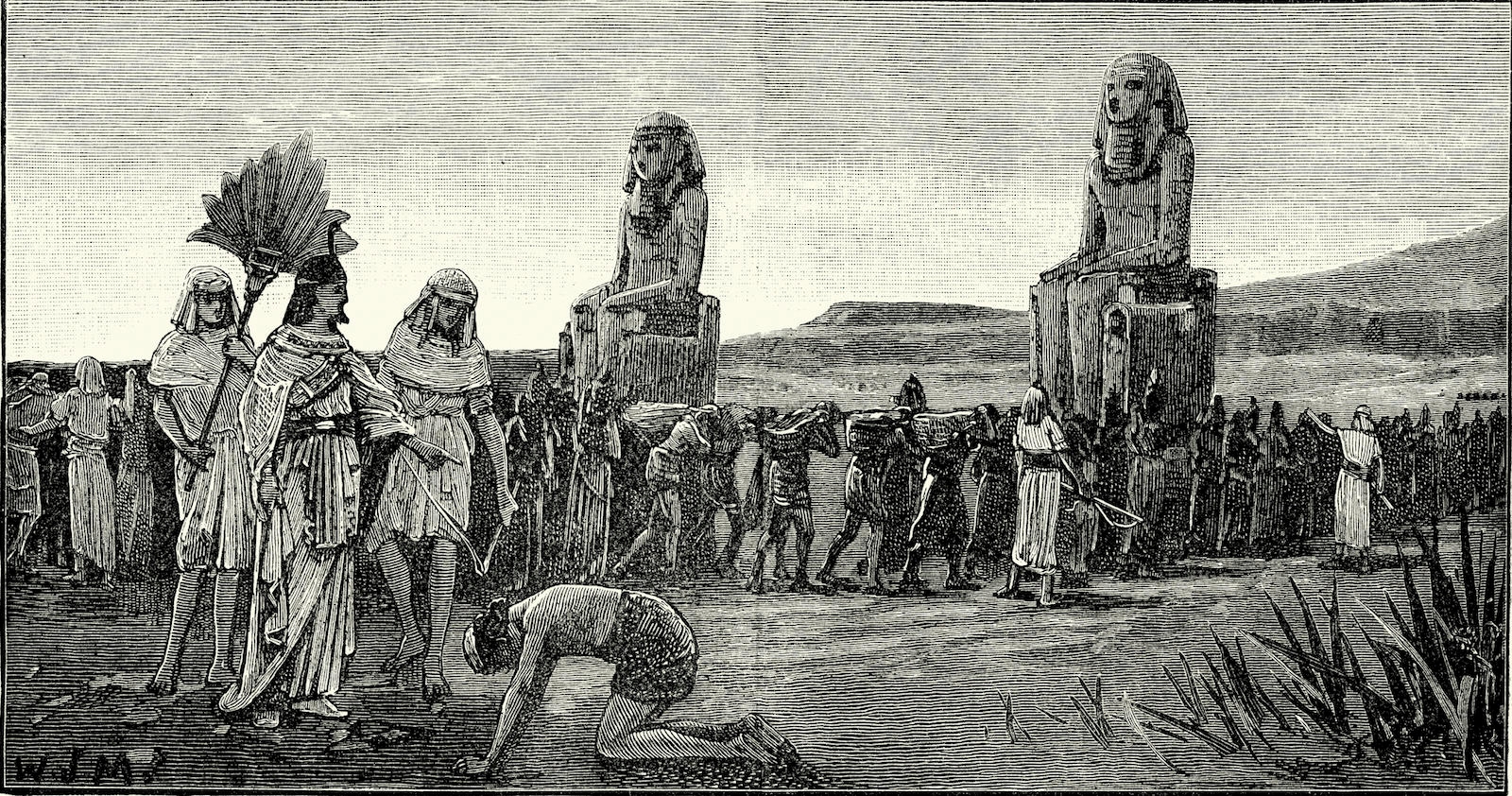
But we should read Mishpatim more carefully, because it’s here that we learn what God really meant by making these words the prologue to the Ten Commandments: I am Adonai your God, the one who brought you out from the land of Egypt, the house of slaves. By looking at two sets of laws which structure this parashah, we can uncover what it means for us to live our everyday lives with the awareness of former slaves.
Laws on Slavery
The very first law in Mishpatim seems at first glance to be built on the opposite idea. It begins: “When you buy a Hebrew slave…” Stop right there!–how can the Israelites, so fresh out of Egypt, be buying each other as slaves?
To answer the question we have to continue reading. “Six years he shall work, and in the seventh you shalllet him go, free, without payment.” A couple of things catch our attention. One is surely the numbers, six and seven, which remind us of the weekly cycle of work and rest characteristic of free people. The other is most apparent in Hebrew. The word “y’shalchenu, he shall let him go,” is built from the same root as Moses’ famous demand of Pharaoh, uttered in God’s name: “Shalach et ami, Let My people go!”
With your help, My Jewish Learning can provide endless opportunities for learning, connection and discovery.
We are being told here that the act of freeing a personal slave is really the same as God’s act of freeing an entire nation from slavery. And the parallel builds: “But if the slave declares, ‘I love my master…I do not wish to go free,’ his master shall take him before God. He shall be brought to the door [or the doorpost; mezuzah, in Hebrew] and his master shall pierce his ear with an awl–and he shall then remain his slave for life.”
My teacher Rabbi Ed Greenstein explains that if you pierce an ear at the doorpost, what is left behind is a spot of blood. That detail completes the parallel between the slave owner in Israel and the Blessed Holy One in Egypt. The master who wishes to free his slave recreates the scene of the last night in Egypt. There, the slaves performed their first act as free people, defying the Egyptians by smearing blood on their doorposts from the sacrifice of a lamb, an animal sacred to the oppressors. In Mishpatim, by contrast, the master in effect says to the slave:”I want you free. You could walk out this door into freedom. If you don’t, it’s not because I didn’t try, not because I held you back, not because I desired to oppress you.”
This law, in the end, is not really about permission to keep slaves. In its historical time, the Torah presumed a society where there were slaves, who had sold themselves because of debts or poverty. The law emphasizes instead the freeing. The very first thing these former slaves are being told is not to become like their Egyptian oppressors. They are being told to free their slaves–not only to offer freedom, but to sing it loud, to pull out all the stops, even to the point of creating a mini-drama about oppression and freedom.
Lessons Are Useful Today
The lesson is the same for our time and our society. We do not own slaves anymore, but as a society we tolerate oppression and participate in it. We tolerate a two-tiered society, where some have access to education and encouragement, to wealth and the means to make it, and others far less so. We tolerate the attitudes that let this continue–the lazy stereotypes about people of different colors and about “the poor,” the lazy fatalist feeling that there are no real solutions. This is, in our time, what it means to buy and keep a slave of our own people.
The Torah commands us, living today, to free the oppressed around us. To set a limit to the time we are willing to tolerate the inequities and injustices before we rid ourselves of slavery. The first law set down by the God who brought us out of slavery is to go back, split the sea, and rescue those for whom life among us is still life in Egypt.
The law of the Hebrew slave freed in the seventh year begins the law code of Mishpatim. The code ends with a final series of laws, and the laws that open that this final section each evoke and extend one aspect of the law of the slave. “Do not oppress the stranger–because you know what it is like to be a slave. Six years you shall sow the land and gather its produce, but in the seventh you shall let it rest–so that your wealth belongs for one year to the needy.”
And finally, “six days you shall do your work, but on the seventh day you shall cease from labor.” It is significant that Shabbat, the command to rest each week in celebration of our own freedom, is at the end of the list. Only when the strangers are welcome does our freedom have any meaning. Only when the hungry are fed does Shabbat, the pinnacle of Jewish spiritual life, have any significance.
And it works the other way, too–Shabbat is a daylong meditation on the responsibilities of free people in a society not yet rid of the suffering made by human beings. We must enter each new week like the master in Mishpatim, unsatisfied to see that suffering continues, blood on the door but the people still trapped inside.
The Blessed Holy One went first–“I am Adonai your God, the One who brought you out of the land of Egypt, the house of slaves.” The laws of Mishpatim teach us to go next, to keep on going, to be like God, so that we too can say that we have brought every last person out of Egypt, out of the house of slaves.
Provided by SocialAction.com, an online Jewish magazine dedicated to pursuing justice, building community, and repairing the world.
Adonai
Pronounced: ah-doe-NYE, Origin: Hebrew, a name for God.
Torah
Pronunced: TORE-uh, Origin: Hebrew, the Five Books of Moses.