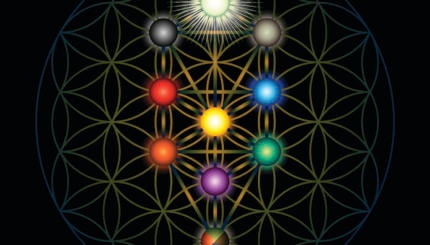
The kabbahistic [mystical] literature, which reached its proper formulation at the beginning of the 13th century, exhibits three approaches to the land of Israel: (1) the theosophical, beginning with the works of the Provençal Isaac the Blind and the kabbalists of Gerona, Ezra and Azriel, which reflect, in the main, the symbolic development of the image of the land of Israel; (2) the theurgic, as expressed in the writings of Nahmanides; and (3) the personal, as in the ecstatic kabbalah of Abraham Abulafia.
The Land & Sefirot
We begin with the theosophical approach. In the earliest stages of kabbalah, the Land of Israel in general and Jerusalem in particular were assumed to represent the uppermost sefirot [different categories of divine emanations], particularly, Wisdom, Foundation, and Kingship. As the sefirot represent hidden divine powers, the land of Israel itself becomes a manifestation of supernal, divine aspects. The kabbalists thus set the terrestrial land aside in favor of the celestial land of Israel, focusing attention on its inner, divine dimensions. At Leviticus, 84a, the Zohar, edited at the end of the 13th century, illustrates this approach. The text comments on a talmudic legend according to which the entire land of Israel was “rolled up” beneath Jacob as he slept on his flight from Beersheba to Haran (B. Hul. 91b):
 “How is it possible that the land of Israel, which measures 400 by 400 miles, was uprooted from its place to come beneath him? Nay, the Holy One, blessed be he, has another, supernal, Holy Land, also called the land of Israel, and it is beneath the level of Jacob on which he stands.”
This “other land” of the mystic is the sefirah of Kingship, which stands beneath the sefirah of Glory, symbolized both by the term “the Holy One, blessed be he” and by the name “Jacob.”
With your help, My Jewish Learning can provide endless opportunities for learning, connection and discovery.
Symbolism
This fundamental symbolism of the land has further implications and ramifications. First, the land of Israel reflects the ineffable name of God, which is surrounded by other divine names (Ezra of Gerona). Second, the land of Israel and its cities also represent a sexual aspect. The first sin caused a split between the masculine principle of the divine powers (symbolized by the sefirah of Glory or Foundation) and the feminine principle (symbolized by Kingship).
The coupling of the two principles is already symbolized in early Kabbalah by the unification of “Zion” (Glory or Foundation) and “Jerusalem” (Kingship). Since the righteous person similarly is symbolized by the sefirah of Foundation, the sexual aspect is also reflected in the fact that only perfectly righteous people can possess the land. Third, there were mixed implications for messianic activism. Some authorities considered the kabbalistic activity symbolized by the land of Israel as a substitute for active immigration to that country, while others, on the contrary, considered it a catalyst for immigration.
The Zohar presents a broad variety of concepts of the land of Israel besides the theosophical dimension and its sexual implications:
All these combined with the philosophies already formulated by Judah Halevi and Abraham ibn Ezra in a final consolidation of the theosophical conception. The Zohar uses climatological considerations to explain the position of the land of Israel at the center of the universe, the fact that the land is suited exclusively for the Jewish nation and that, contrary to other countries, it is not affected by the normal astrological system. The various theosophical traditions were summed up and merged with other conceptions of the status of the land of Israel in the many works of Moses Cordovero (Safed, 16th century), particularly in his commentary Or Yakar to the Zohar. A more concise account may be found in Hesed le-Avraham by Abraham Azulai (Morocco and Palestine, 16th century).
Nahmanides
The second approach to the land or Israel among 13th-century kabbalists is well represented by the thought of Moses b. Nachman of Gerona, better known as Nahmanides or by the acronym Ramban. This approach is more concerned with the theurgic action of the commandments in the Holy Land than with its symbolism, though it too relies directly and indirectly on Judah Halevi and Abraham ibn Ezra.
An important point here is Nahmanides’ sharp criticism of Maimonides’ failure to count settlement of the land of Israel as one of the 613 commandments. Among the commandments that Nahmanides added in his hassagot (“criticisms”) of Maimonides’ Sefer ha-Mizvot was the injunction “to inherit the land that God, blessed and praised be He, gave our ancestors, Abraham, Isaac, and Jacob, and it has never been abandoned to the hands of any other nation or to desolation.” In Ramban’s view, this injunction is “a positive commandment for all generations, binding upon every individual even in the time of exile, as stated frequently in the Talmud.”
In addition, Nahmanides insisted that observance of the commandments was intended solely for the land of Israel, with their observance in the Diaspora merely a preparation for the nation’s future return to its land.
Nahmanides took his own conclusions seriously and immigrated to the land of Israel. It is noteworthy that, by contrast, several Ashkenazic [European] scholars ruled out immigration to the Holy Land, not only because of the dangers attendant on the journey but also because not all the commandments can be fulfilled in the present. This is the approach taken in a responsum [rabbinic legal decision] of Hayyim b. Hananel Hakohen (Paris, second half of 12th cent.), cited in Tosafot to B. Ket. I l0a. But Nahmanides thought otherwise, and his conception of the commandments was in full accord with his kabbalistic ideas, for arguing that we have no tradition concerning the secrets of the Merkavah (the “Divine Chariot” or Throne of God), he confined his kabbalistic deliberations to the reasons for the commandments.
Accordingly, Nahmanides’ view of the kabbalistic significance of the land focused on the theurgic effect of religious observance there. As he enveloped his teachings in enigmatic language, this theurgic action may be explained in two ways: harmony in the world of the sefirot is achieved by proper observance of the commandments, which possess authentic meaning in the Holy Land alone, or the commandments are also understood as instruments through which the divine emanation (shefa)–which exists in its most supreme manifestations in the Holy Land–is brought down to earth.
Thus, Nahmanides evolved a special magical-astral theory, according to which divine emanation in itself is uniform but of dual significance: In its supreme aspect it is the theosophical emanation, emitted and brought down from the world of the sefirot; in its lowly aspect it is an astral emanation, which can be captured by magical-astral means, such as sacrifices or expiation (as in the case of the “scapegoat”).
In this connection, it should be noted that Nahmanides had considerable esteem for magic, viewed as “an ancient and true science” the Jews had possessed but lost in exile. In his view, astral magic was the basis for all other forms of magic. A similar magical-astral conception had evolved in North African kabbalah as well, as represented by Judah b. Nissim ibn Malkah. Thus the Land of Israel was of supreme significance for Nahmanides, whether from a theosophical standpoint or an astrological one. It was there that the attraction of emanation is the most efficient and massive. This view of the centrality of the Holy Land in theosophical and .theurgic lore pervaded the writings of Nahmanides’ circle in the late 14th and early 14th centuries, as represented by such thinkers as Solomon b. Adret and Bahya b. Asher.
Abraham Abulafia
A third approach is represented by the circle of Abraham Abulafia, the creator of ecstatic kabbalah, active in the mid-13th and 14th centuries. Members of this circle were active in the Land of Israel, such as the author of the book Shaarei Tzedek (Gates of Righteousness) and Isaac of Acre. Abulafia and Isaac considered the land of Israel and its cities symbols of the individual’s soul or of the inner processes taking place in the soul, which lead to communion and conjunction with the deity.
Isaac of Acre writes (Ozar Hayyim, MS. Moscow 775, fol. 94a):
“The secret of foreign lands and the land of Israel… is not a land of earthly soil, but it is the souls that reside in a lump of earth…
And even though it [the soul] is in a foreign land, the Divine Presence (Hebrew, Shekhinah) rests upon it, and that is surely the land of Israel.”
In this sense, Abulafia’s group took a view close to that of the philosophical allegory, which transplanted the real existence of the land of Israel to an ultimate personal level. The implications of this approach in counteracting the thrust of messianism are obvious, in direct opposition to the school of Nahmanides.
Reprinted with the permission of The Continuum International Publishing Group from
The Encyclopedia of Judaism, edited by Jacob Neusner, Alan Avery-Peck, and William Scott Green.
Kabbalah
Pronounced: kah-bah-LAH, sometimes kuh-BAHL-uh, Origin: Hebrew, Jewish mysticism.
Zohar
Pronounced: ZOE-har, Origin: Aramaic, a Torah commentary and foundational text of Jewish mysticism.