Eastern European Jews arrived in the United States at the very apogee of unrestrained American capitalism. Early working‑class efforts to unionize, to strike, almost invariably failed. Among East European Jews, these initial unionizing ventures proved even more difficult than for other laborers. Most Jews worked in sweatshops, in tenement quarters that were too small to foster a collective, unionist outlook.
As early as 1885, garment workers participated in a brief, spontaneous walkout of some 10,000 cloak and skirt makers. Once they achieved a few minor concessions, however, they drifted away, allowing their union to die, and the improvements gradually were rescinded. Other occasional local strikes flickered out in ensuing years.
Jewish workers appeared “unorganizable,” lamented Morris Hillquit [union organizer and intellectual leader of the American Socialist Party] some years later. They were “dull, apathetic, unintelligent.” In 1888, at the initiative of Bernard Weinstein, a 19‑year‑old shirtmaker and a recent Bundist activist in Russia, Hillquit and several other Lower East Side Jews founded the United Hebrew Trades.
In current terminology, the organization’s purpose was one of “consciousness‑raising,” simply of fostering union organization within the garment industry and other “Jewish” trades. And indeed, by 1890, the little group managed to establish some 22 unions, including a typographers union, a shirtmakers union, a knee‑pants‑makers union, a cloak‑makers union, a cap‑makers union, a bakers union, even a Yiddish actors union.
With your help, My Jewish Learning can provide endless opportunities for learning, connection and discovery.
Their early idealism doubtless was intense, even messianic, but it was still essentially unfocused. Early in its history, the United Hebrew Trades enthusiastically accepted founder and leader of the New York-based Labor Socialist Labor Party Daniel De Leon’s request for union participation in a May Day parade. Ostensibly a demonstration for the eight-hour workday, the event signified much more to the 9,000 marching Jews.
Bands played the Marseillaise and workers’ songs. Red flags fluttered from hundreds of tenement windows. Marchers among the 16 Jewish unions and socialist organizations making their way to Union Square carried placards reading “Bread and Freedom” and “Down with Wage Slavery.” A continuous rain could not dampen the crowd’s spirits. Abraham Cahan, one of the speakers, proclaimed “this imposing demonstration … [is] the beginning of the great revolution which will overthrow the capitalist system and erect a new society on the foundation of genuine liberty, equality, and fraternity.” De Leon and others orated in the same vein. None of the speakers paid much attention to the issue of the eight‑hour workday.
Eventually they would have to. It was the warning of the newly established American Federation of Labor, and specifically of its president, Samuel Gompers. Born of Dutch‑Sephardic parents in the ghetto of London, Gompers had come to the United States as a teenager in the midst of the Civil War. Employed as a cigar roller on New York’s Lower East Side, he participated in the founding of the cigar-makers union, then worked his way up through the German‑language Central Labor Council. In 1886 he negotiated the formation of the American Federation of Labor and became its first president. As philosophically pedestrian as De Leon was intellectually charismatic, Gompers was entirely pragmatic in his approach to working‑class issues. Ideologies held no interest for him. As he saw it, free enterprise was a fact of life, and he was determined to fight for labor’s rights within that system.
Without Jewish loyalties or concerns, Gompers at first made no secret of his distaste for the United Hebrew Trades and its windy messianism. In turn, their membership heartily reciprocated his suspicions. But with the demise of De Leon’s Socialist Labor party, the United Hebrew Trades was left with little choice except to allow its unions a certain tentative identification with the AFL. The latter appeared clearly to be the single labor organization capable of achieving bread‑and‑butter improvements for the working man.
With the encouragement of Hillquit, of [Meyer] London [Socialist politician from New York], and eventually even of Eugene Debs, the Jewish unions agreed then to concentrate for the time being simply on achieving stability. They anticipated that the AFL’s moral support and guidance in the long run would add to their strength, and they were not wrong.
In the short run, however, it was the resourcefulness of the Jewish labor force itself that played the decisive role in the unionizing effort. The initial battleground was the women’s garment industry. Here, for immigrant Jews, tactical direction emerged as early as 1890, when the 25‑year‑old Joseph Barondess, only two years in the United States, organized the cloak makers, the single largest subcommunity within the needle trades.
Burning‑eyed and mustachioed, affecting the flamboyant demeanor of a bohemian aristocrat, Barondess won the hearts of his fellow workers with his soaring voice and gift for lacing radical agitation with talmudic epigrams. It was Barondess in 1890 who organized a strike of 3,000 cloak makers, almost miraculously sustaining the discipline and morale of his fellow picketers through eight weeks of police brutality, strong‑arm goons, and economic deprivation and hunger. In the end, management conceded a modest reduction of hours and workload.
Barondess and other labor leaders then spent the next few years struggling to consolidate their union. It was painful, drudging work throughout the 1890s. Upon resolving a specific grievance, these early Jewish garment workers often allowed their union dues to lapse. Painstakingly accumulating their savings, many either sent for families in Europe or ventured into business on their own as subcontractors or petty retailers. As late as 1905, Abraham Bisno, deputy inspector of factories for the State of Illinois, suggested in a report on Chicago’s men’s clothing industry that “most of the [Jewish factory workers] do not believe themselves to be working men for life, nor do they think that they will leave as a heritage to their children the lot of a wage‑worker. . . .”
It was a series of new developments that gave the Jewish union movement an unexpected lease on life. One was the early‑20th century wave of immigrating Bundists. In their ideological zeal and commitment, these hard‑edged Socialists provided a vital infusion of staying power. Ironically, so did the growth of the clothing industry itself, particularly its New York‑based women’s‑garment branch.
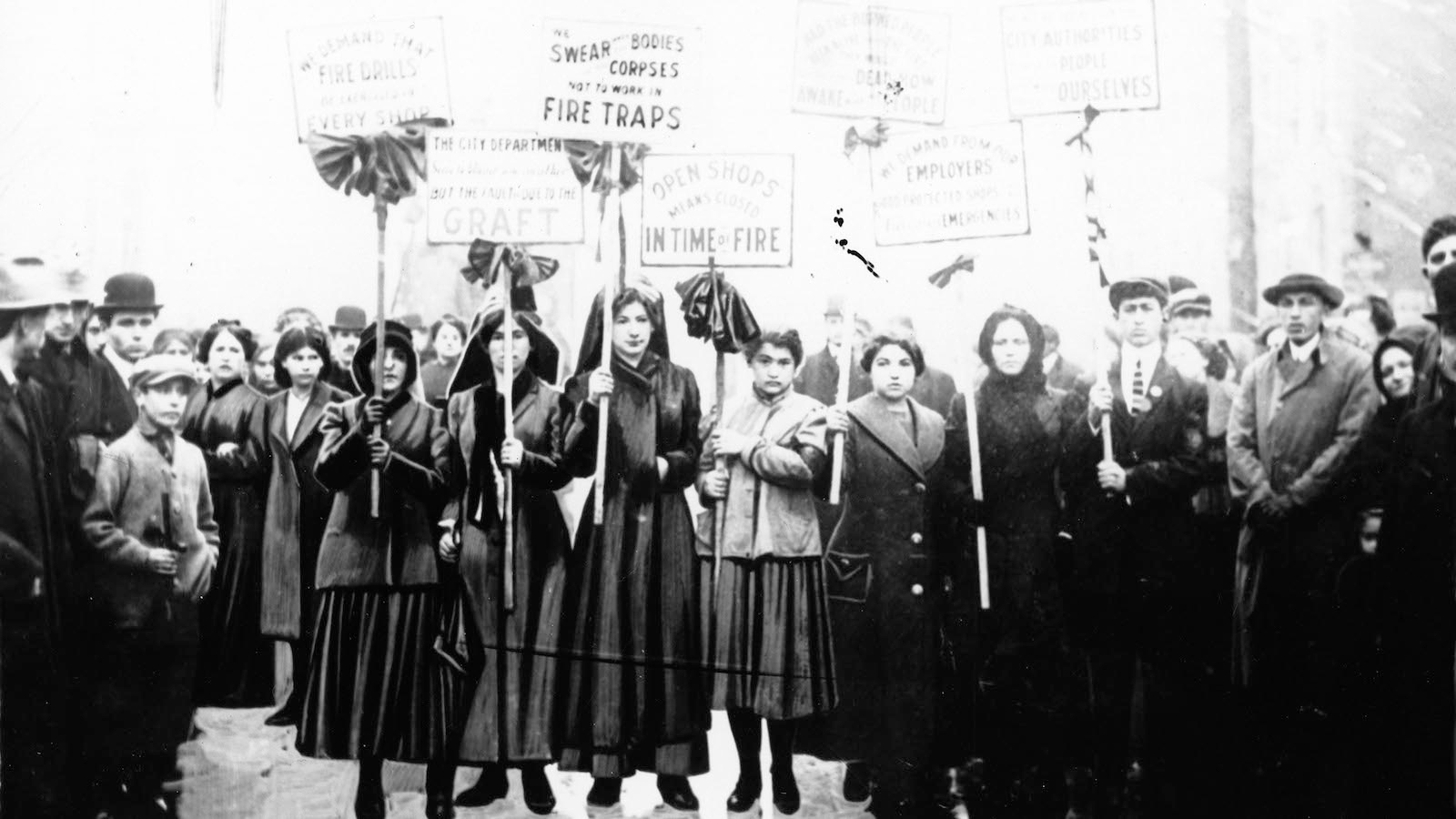
Over the first decade of the new century, women’s clothing became the third largest consumer‑goods industry in the United States. In 1900, the number of its factories totaled 1,224. In 1910, the figure reached 21,701. In the same period, the number of its workers rose from 31,000 to 84,000. With this growth, and the introduction of newer, more efficient machinery, the older sweatshop-‑haphazardly organized, economically redundant –soon disappeared.
The shift from sweatshop to factory in turn provided a more effective basis for unionization. Workers no longer were isolated from each other, as they had been earlier, dispersed among tenement flats. Crowded together now in factories, they were positioned to share their grievances and complaints, to collaborate for group action.
Still another factor accounting for the upsurge of labor activity was a consolidation of individual unions within the women’s‑garment industry. Separate locals continued to function-‑of cloak makers, pressers, cutters, shirtwaist makers, and others. For years they would organize individually and strike individually. In 1900, however, under persistent exhortation by Gompers and the AFL leadership, the various unions agreed to collaborate at least in an umbrella organization, the International Ladies Garment Workers Union.
The ILGWU was not about to turn conservative. Endlessly infused with Bundist idealism, it would for years constitute the single most radical component within the AFL. Yet the “respectable” new imprimatur of AFL membership, as well as the garment workers’ sheer consolidation in numbers, offered a dimension to be taken seriously. With the economy booming in post‑Spanish‑American War years, organized labor was making giant strides. In 1900 alone, some four hundred fifty thousand new workers flocked to the AFL. Responding to the confluence of these factors, the ILGWU by 1909 had grown to 63 locals encompassing 16,000 members. Here at last was a Jewish proletariat structured to challenge the inferno of the clothing factory head‑on.
This article is reprinted from A History of the Jews in America, written by Howard Sachar and published by Knopf.