The extent of the Jewish influence on American popular music before the age of rock is seen clearly in the musical. This American art form attracted the attention of the greatest songwriters of the pre-rock era: Jerome Kern, George and Ira Gershwin, Oscar Hammerstein, Richard Rodgers, Lorenz Hart, Cole Porter, Alan Lerner and Frederick Loewe, not to mention Irving Berlin. Between them, they wrote the songs for practically all the great musicals of the ’30s and ’40s. Nor should one forget Harold Arlen and Yip Harburg, who wrote the songs for the greatest of the screen musicals, The Wizard of Oz.
With the exception of Cole Porter, all the above-named were Jewish. The tradition of the Jewish musical writer, in fact, continued into the rock era with Stephen Sondheim, Leonard Bernstein, and Lionel Bart.
Jewish Music?
Cole Porter was aware that he was working in a medium that was disproportionately Jewish. He once told Richard Rogers that he had discovered the secret for writing hits: “I’ll write Jewish tunes,” he claimed.Porter’s comment was echoed by Jerome Kern, who, unlike Porter, was himself Jewish. Apparently, Oscar Hammerstein once asked what sort of music Kern would be writing for a stage musical about the life of Marco Polo. Kern replied: “It’ll be good Jewish music.”
In one sense the music wasn’t “Jewish music” and Porter’s tunes weren’t “Jewish tunes.” The Jewish composers were not simply adapting the Yiddish tunes of the ghetto for an English-speaking audience. They were drawing on the wider musical traditions of America. As Jeffrey Melnick has argued in his important book, A Right To Sing The Blues, the Jewish songwriters were, above all, adapting the music of African Americans. First, they took inspiration from ragtime music and, later, from jazz.
With your help, My Jewish Learning can provide endless opportunities for learning, connection and discovery.
Irving Berlin
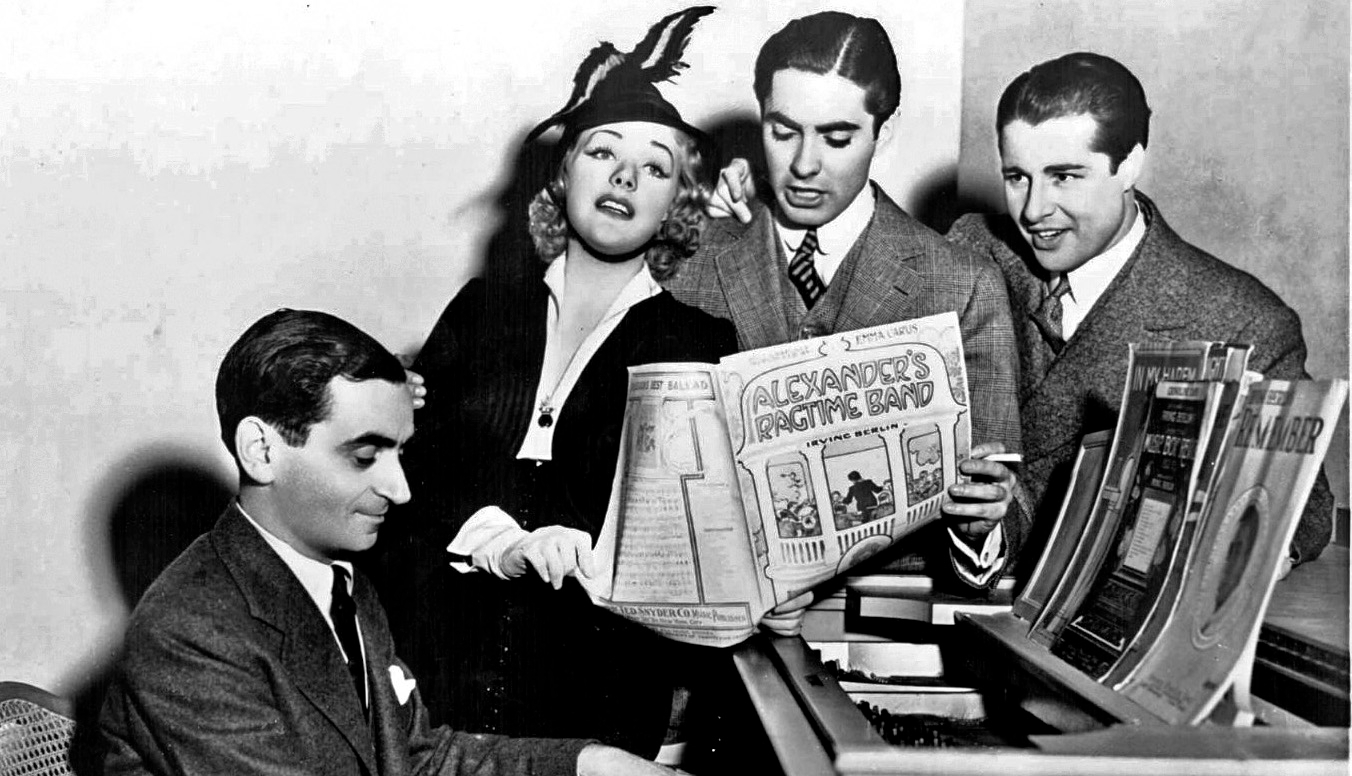
Irving Berlin, in particular, was fascinated by the syncopated rhythms of ragtime. His first huge success was “Alexander’s Ragtime Band” in 1911, which, in fact, proved to be Tin Pan Alley’s biggest hit up to that time. The previous year, Berlin had written “Yiddle On Your Fiddle, Play Some Ragtime.” It had been a novelty number–an early song with essentially the same message as Chuck Berry’s “Roll Over Beethoven.” Move over, traditional music–something snappier is on the way. And the snappier stuff was coming from black music.
Berlin’s song, unlike Berry’s, addressed a particular ethnic group: “Yiddles” should start picking out the ragtime beat on their fiddles. The enormous success of “Alexander’s Ragtime Band,” selling across ethnic divides, taught Berlin to address the whole of America, not just the Yiddles with their fiddles.
If Berlin borrowed African American rhythms and styles, then inevitably there were charges of plagiarism and exploitation. Scott Joplin, for one, thought that “Alexander’s Rag Time Band” had been based on his own work, and he complained about receiving neither the recognition nor the financial remuneration. It was even rumored that Berlin kept “a little colored boy” in his basement to write his songs. With charges of exploitation came those of debasement. Berlin and others, it was said, were sentimentalizing ragtime, stripping it of its authenticity.
Was The Jazz Singer a Jazz Singer?
When, in the Twenties and Thirties, the craze for ragtime gave way to that for jazz, there were similar accusations again. Al Jolson was the first big “pop” star of the jazz age. He was the son of a cantor. His hit “Swanee” was George Gershwin’s first big success. The charges of sentimentalizing and parodying African American music are easy to make in Jolson’s case. Like many other Jewish vaudeville performers of that era, Jolson did not appear on stage as a Jew. He blacked up his face, playing in the tradition of minstrelsy singing ersatz “minstrel” songs.
Jolson’s major film, the first “singing talkie,” was called The Jazz Singer. Interestingly, in the film Jolson played a popular Jewish blackface singer, Jack Rubin, who became famous for his sentimental songs. Unusually, this film told a Jewish story. It portrayed the conflict between the old ways, depicted by Rubin’s father, a traditional cantor, and the new ways of America, represented by Rubin’s Christian girlfriend. The message was essentially assimilationist. Despite the film’s success, it was a one-off: The major companies backed away from producing other obviously Jewish films. The film’s title showed how the word “jazz” was becoming loosely used. It is highly debatable whether Jolson, or the character he played in the film, should properly be termed a “jazz singer.”
Other Jewish composers and musicians, who had a deep-seated feel for jazz, would have certainly disputed Jolson’s claims to be a jazz singer. Harold Arlen (nee Hyman Arluck), to a much greater extent than Irving Berlin, respected the black musical traditions from which he was borrowing. Indeed, Arlen specifically took pride in writing for black jazz singers at Harlem’s Cotton Club, including most notably Cab Calloway.
There were Jewish jazz musician-composers–like Benny Goodman, Mel Torme, and Artie Shaw–who played with black musicians and who consciously aimed to develop, not debase, jazz forms. They did not seek to transpose the complexities of jazz into catchy show tunes. Certainly, they did not appear on stage with blacked-up faces, repeating the parodied gestures of the stage “coon.”
George Gershwin
Towering over all the other Jewish composers of Tin Pan Alley stands the figure of George Gershwin. Not only could he write a hit tune and turn out perfectly crafted songs for shows, but he wrote longer orchestrated pieces which bridged the gap between high and popular culture. He combined the traditions of European classical music with pop, jazz, and blues. Rhapsody in Blue is a classic case in point. It is neither a symphony nor is it jazz in a narrow sense. Nor is it an overture to a musical. It combines different musical forms to create something new.
In doing this, Gershwin was representing the position of the immigrant, wide-eyed and open-eared in the newly adopted lands. As Jeffrey Melnick claims, it is no coincidence that it was a Jew who tried to forge unity from such musical diversity, in order to synthesize a new American music. A Jew, such as Gershwin, did not want to remain stuck in the confines of tradition but was eager to embrace new musical influences. He had no hesitation–no restricting prejudices–against celebrating the art of black Americans. In fact, Gershwin grew up in Harlem and from an early age he was fascinated by the music he could hear on the streets. Later, with his brother Ira, George would visit the music cafes and get to know local black musicians and composers, such as Willie “the Lion” Smith and James P. Johnson.
In Gershwin’s musical synthesis, Jewish music was not to the fore. Some claim that echoes of klezmer music can be heard in the famous opening bars of Rhapsody in Blue. Tellingly, this echo is soon swamped in the main piece by modern rhythms. Gershwin had made plans to write a musical version of the old Yiddish folktale, The Dybbuk. Significantly, nothing came of this. Porgy and Bess, dealing with black characters in the Deep South, emerged instead. George and Ira collaborated with DuBose Heyward to turn the latter’s novel into a musical. Thankfully nothing came of an earlier plan to commission Hammerstein and Kern to write the score and then to use Al Jolson in the main role, complete with blackface.
Reprinted with permission from Rock ‘N’ Roll Jews (Five Leaves Publications).