It is common for Jews to affectionately refer to the first Patriarch as Avraham Avinu, “Abraham our Father.” But is Abraham so certainly “our father” alone?
If we approach the figure of Abraham from the perspective of later Jewish exegesis, we note a number of additions to Abraham’s biography that seem peculiar and unwarranted by the biblical text. A more careful examination of the circumstances reveals that some of these added details reflect some very heated controversies that preoccupied the Jewish commentators through the generations in their contacts with competing religious outlooks.
As an example, let us look at an oft-quoted rabbinic tradition:
Our father Abraham observed the entire Torah before it was given to Israel, as it is written (Genesis 26:5)
“Because that Abraham obeyed my voice and kept my charge, my commandments, my statutes and my laws.” (Mishnah, end of Kiddushin).
This claim, which was extended to apply to the other patriarchs as well, gave rise to all sorts of difficulties.
With your help, My Jewish Learning can provide endless opportunities for learning, connection and discovery.
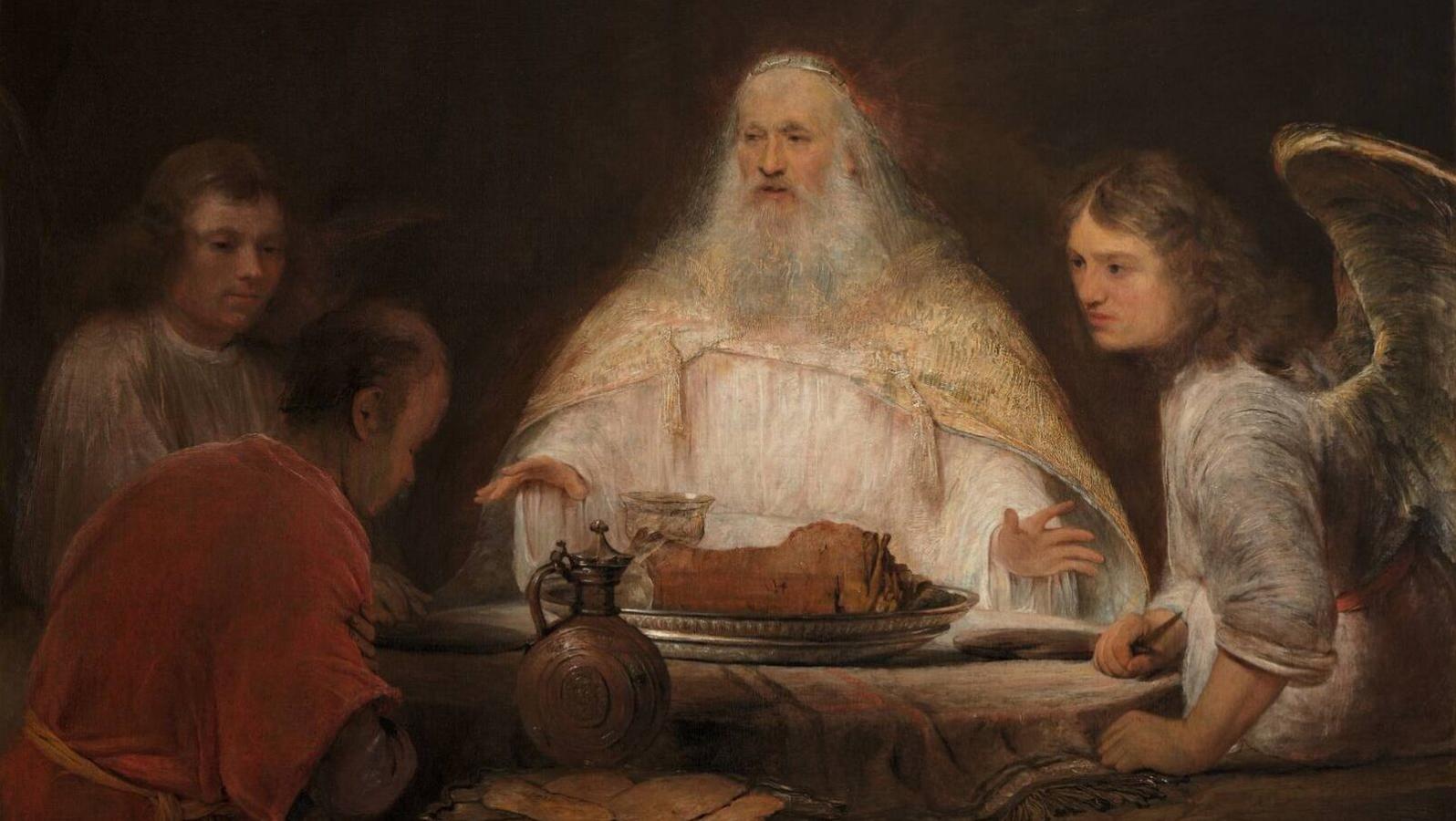
For example, in Genesis 18:7-8, we find Abraham hurrying to prepare a meal for his guests that consisted of “a calf tender and good…curd and milk” — hardly an ideal menu for a kosher meal.
It is possible to interpret the verse cited by the Mishnah in a limited way (as referring, for example, to the basic laws of humanity and justice embodied in the “seven precepts of the sons of Noah“). The Mishnah however insists on applying it to “the entire Torah.” Why did the rabbis insist on making life so difficult for themselves with their sweeping statement?
Abraham in Christianity
A possible explanation might be found in an exposition by a Jew who wrote towards the end of the First Century C.E.
Saul of Tarsus–who was to become known to the world as Paul, the leading ideologist of early Christianity–made considerable use of the model of Abraham to support his own belief that the observance of laws is not conducive to spiritual salvation.
As developed in the fourth chapter of his Epistle to the Romans, Paul points to Genesis 15:6: “And [Abraham] believed in the Lord and he counted it to him for righteousness.” Did Abraham, Paul argues, not live before the receiving of the Torah? Since he did, he could not have observed its laws. Nevertheless, God deems him righteous!
In a typically “midrashic” exposition, Paul notes that the verse in question was placed before the account of Abraham’s circumcision precisely in order to emphasize that circumcision (which for Paul represents the totality of ritual observance) is not a requirement for righteousness or salvation, which are earned through belief and trust in God.
In view of such claims made by the early Church about Abraham, it is perfectly understandable that the rabbis would feel it essential to assert that he was a truly Jewish figure who had observed the precepts of the Torah even before they were made mandatory by the revelation at Mount Sinai.
Abraham in Islam
The Christians were not the only group who claimed to be the true successors of Abraham. With the rise of Islam in the seventh century the Arabs also came to emphasize their descent from the Patriarch.
Interestingly, the descriptions of Abraham’s life as found in the Koran are strongly influenced by Jewish traditions. They incorporate many events not mentioned in the biblical accounts, such as Abraham’s disputes with his idol-worshipping father and his conflict with the wicked king Nimrod who cast him into a fiery furnace. All this provides ample proof that Mohammed had Jewish teachers.
The story of the akedah (binding of Isaac) also found its way into the Koran (37:103), where the story conforms in most respects with the biblical version. Later Islamic tradition took it for granted that the sacrificed son was actually Ishmael, the ancestor of the Arabs.
Yet another aspect of the complex inter-relationships between Judaism, Christianity, and Islam is demonstrated by the following example.
The covenant between God and Abraham, as described in Genesis 15, is accompanied by a queer ceremony of splitting the carcasses of various animals into pieces. Verse 11 relates, “And the birds of prey came down upon the carcases, and Abraham drove them away.”
A medieval Yemenite midrashic anthology, the Midrash Ha-Gadol, explains this as meaning that “when Abraham laid the halves of the pieces over against each other, they became alive and flew away,” this being God’s way of demonstrating to him the doctrine of Resurrection of the Dead.
This detail is not mentioned, as far as I am aware, by any talmudic source, though it is alluded to in the Arabic translation of the great 10th-century scholar Rav Saadiah Gaon, who interpreted the Hebrew phrase vayashev otam Avram, normally rendered as “Abram drove [the birds] away,” as “Abraham revived them.”
The earliest attested version of the legend seems to be the following:
And when Abraham said: “Lord show me how you will revive the dead,” He said, “What, do you not yet believe?” Said he, “Yea, but that my heart may be quieted.” He said, “Then take four birds, and take them close to yourself; then put a part of them on every mountain; then call them, and they will come to you in haste; and know that God is mighty, wise.”
The source for this midrash? It is found in the Koran (2:260).
It would appear possible that later Jewish commentators were making free use of an Islamic tradition that provided corroboration for the Jewish belief in resurrection. The desire to find biblical support for the crucial doctrine of resurrection had long preoccupied the Talmudic rabbis, and Mohammed’s exegesis offered a convenient proof-text. The interpretation sounded so “orthodox” that its true origin was eventually forgotten. The possibility should not however be discounted that Mohammed himself may have been citing an originally Jewish teaching which was not preserved in our own sources.
Conclusion
It is evident that all three of the great Western religions have laid claim to “Abraham our father.” And the intricate web of relationships between these religions — including both conflicts and points of agreement and harmony — can be traced through the examination of their respective interpretations of Abraham’s life.
In addition, as has been evident throughout our history, the interpretations Jews have given to the Scriptures often reflect pressing concerns that go far beyond the particular verses that are being expounded.
For this reason, the study of Jewish biblical exegesis offers a most challenging and rewarding way of exploring the development of Jewish thought and history.
Reprinted with permission of the author from the Jewish Star.
kosher
Pronounced: KOH-sher, Origin: Hebrew, adhering to kashrut, the traditional Jewish dietary laws.
Mishnah
Pronounced: MISH-nuh, Origin: Hebrew, code of Jewish law compiled in the first centuries of the Common Era. Together with the Gemara, it makes up the Talmud.
Torah
Pronunced: TORE-uh, Origin: Hebrew, the Five Books of Moses.