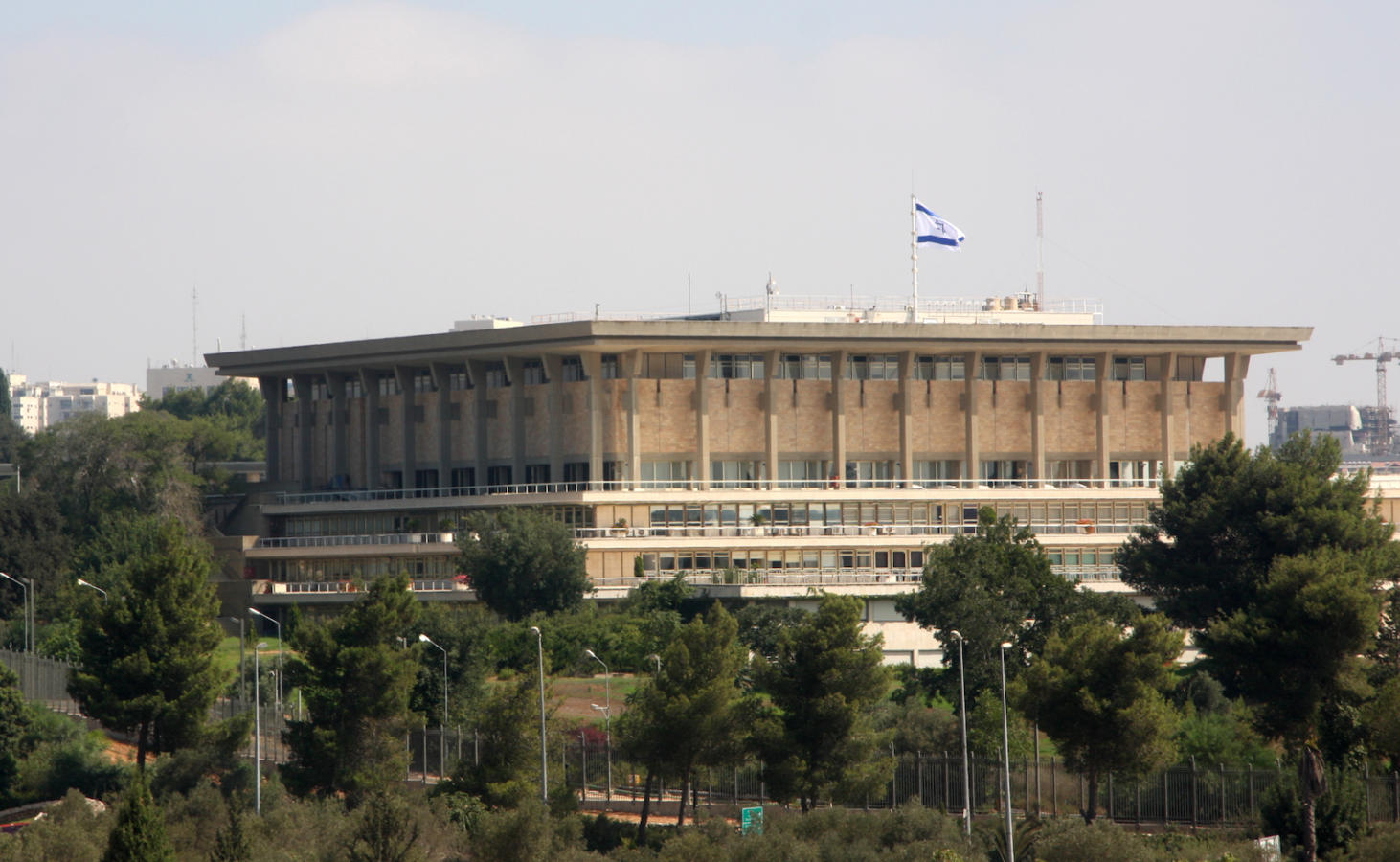
Israel’s government is a parliamentary democracy. The Israeli political system has three branches: executive, legislative and judicial. The legislative branch is comprised of the Knesset, Israel’s parliament, which has 120 members.
Members are elected to the Israeli legislature via proportional representation. Each election cycle, the contending parties present a list of candidates and voters opt for a particular party rather than a specific candidate. Parties are awarded seats in the Knesset based on the proportion of the vote they capture.
Historically, the two largest parties were the center-right Likud party and the center-left Labor party. Until 1977, Labor was the dominant force in Israeli politics, with every Israeli prime minister a member of Labor or one of its precursor parties. But following the outbreak of the Second Intifada in 2000, Labor began a period of decline. As of 2023, Likud remained the largest party in Knesset.
Since no party in Israeli history has ever managed to secure a 61-vote majority on its own, coalitions are crucial to the functioning of the Israeli political system. This potentially gives smaller political parties more power than they would otherwise have, as their choice to participate in a government can make or break a coalition. Israel has nearly two dozen parties in total, some of which represent the interests of specific segments of society — such as religious Jews, Sephardic Jews or Israeli Arabs — or particular issues, like environmental protection.
With your help, My Jewish Learning can provide endless opportunities for learning, connection and discovery.
The executive branch of Israel is headed by a prime minister (rosh ha-memshala) who is the coalition leader of the Knesset. After an election, the president of Israel formally asks whichever party leader is most likely to be successful in forming a government to attempt to do just that and piece together a majority coalition.
The president of Israel, in contrast to the prime minister, is a largely ceremonial role. As head of state, the president participates in ceremonies and serves as Israel’s representative both in Israel and abroad. The president is elected by the Knesset for a single term of seven years.
The third branch of the government is the judiciary, which consists of courts and tribunals and a Supreme Court. While the State of Israel does not have a constitution, it does have a series of Basic Laws, which function in a similar matter to constitutional laws.
The press has been considered by some to be the “fourth branch” of the government of Israel. The number of daily newspapers sold in Israel is the highest per-capita in the world. About a dozen independent newspapers in several languages — Hebrew, English, Russian, Arabic, and others —are published daily, in addition to several weeklies. The airwaves are also full of hourly news radio broadcasts and two Israeli TV channels, plus cable television that brings in channels from all over the world. While news is subject to a military censor, the news outlets in Israel are independent, serving as a check to governmental power.
Knesset
Pronounced: k'NESS-et, Origin: Hebrew, Israel's parliament, comprising 120 seats.