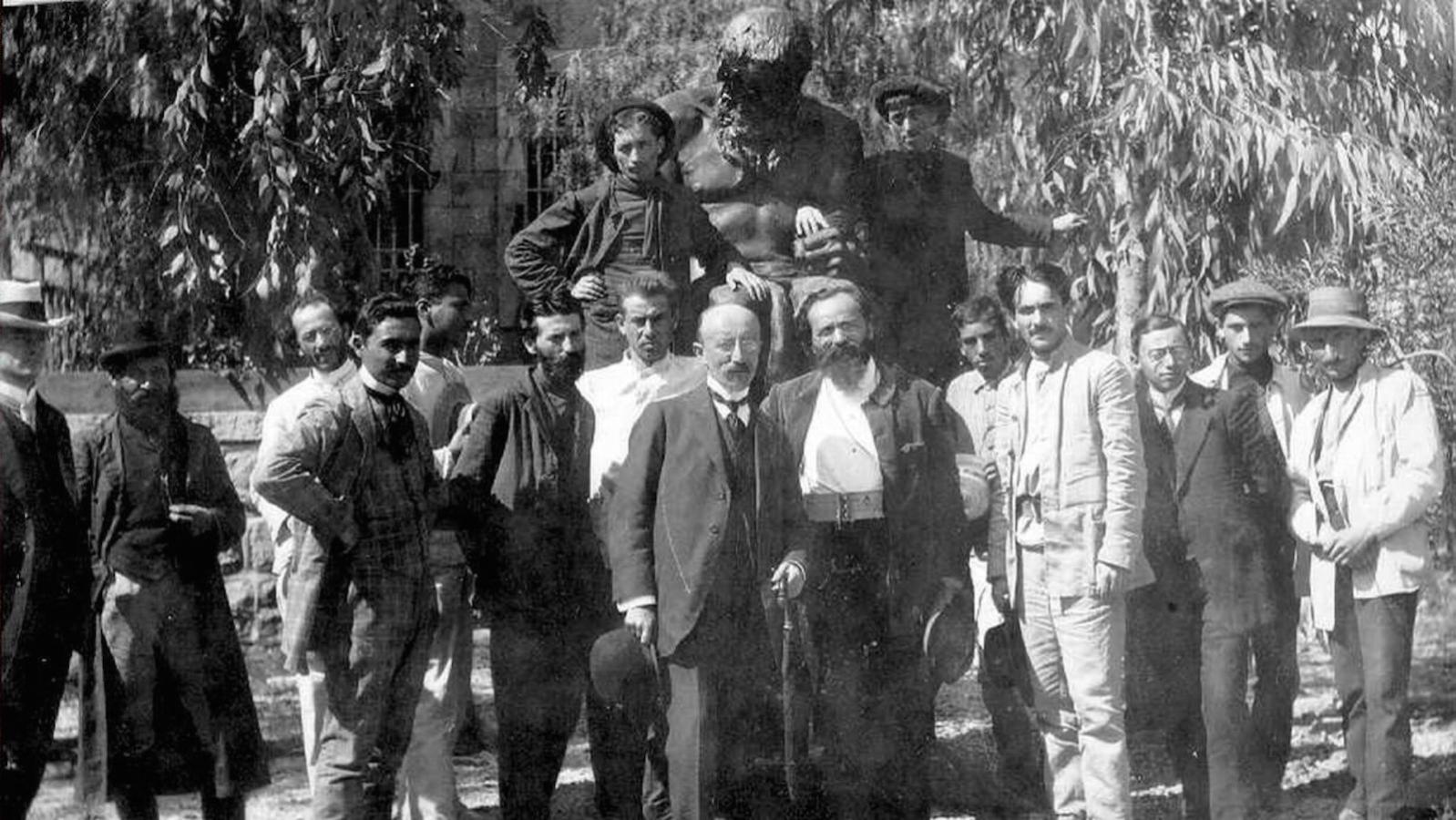
Ahad Ha‑Am,”One of the People”, was the pen‑name of Asher Ginsberg (1856‑1927), Hebrew essayist and Zionist thinker. For Ginsberg, Zionism was important not only because it sought to provide a physical homeland for the Jewish people but because this homeland had the potential of becoming a spiritual center for world Jewry. Ginsberg saw what he called “absolute spirituality” (ruhani ha‑muhlat) as the very essence of Judaism, which had always set its face against material concepts of the divine.
The Talmud tells of the prospective proselyte who came before Hillel asking to be given first a statement about the essential meaning of the Torah “while standing on one leg” (i.e., in capsule form). Ginsberg observes that if such a would‑be proselyte had come to him, his reply would have been to quote the verse: “Thou shalt not make a graven image.” But it has to be appreciated that “spiritual” in these contexts has an intellectual and ethical connotation rather than a religious one.
Ginsberg, though brought up in a strictly traditional home, was a freethinker in religious matters, admiring Judaismfor the stress it puts on intellectual and cultural pursuits and, especially, on a strictly ethical approach. In an essay directed against the views of C. G. Montefiore, who argued for the incorporation into Judaism of some of the higher (for Montefiore) ethical aspects of Christianity, Ginsberg tried to show, not very successfully, that this was not possible, since, apart from the doctrinal aspects, the Christian ethic based on love was incompatible with the Jewish ethic based on justice. Ginsberg’s generalization overlooks the obvious fact that in both the Christian and the Jewish ethic, the tension exists between justice and love and that it is, in any event, precarious to speak of specifically Jewish ethics, ethics being a universal concept.
Ginsberg’s personal life was of a high moral character and, through his writings, he influenced strongly ethics-oriented Jewish thinkers such as Mordecai Kaplan (20th century American Jewish philosopher, founder of Reconstructionist Judaism). With the establishment of the State of Israel, Ginsberg’s thought became somewhat academic. If his essays are still studied in Israel and elsewhere, it is now far more for their fine literary style than for the relevance of the ideas they express.
With your help, My Jewish Learning can provide endless opportunities for learning, connection and discovery.
Ginsberg recognized that the ethical and intellectual aspects of Judaism can only be understood as part of the religious tradition. The modern Jew cannot disown his religious heritage. He must live with it and extrapolate from it the values that have shaped his life. In a famous essay on Moses, Ginsberg remarks that he remains unmoved by scholarly attempts at showing Moses never existed. His Moses, the Moses of the Jewish tradition, still lives on as the powerful advocate of righteous living.
Reprinted with permission from The Jewish Religion: A Companion published by Oxford University Press.
Talmud
Pronounced: TALL-mud, Origin: Hebrew, the set of teachings and commentaries on the Torah that form the basis for Jewish law. Comprised of the Mishnah and the Gemara, it contains the opinions of thousands of rabbis from different periods in Jewish history.
Torah
Pronunced: TORE-uh, Origin: Hebrew, the Five Books of Moses.