Women serve as important agents of ultra-Orthodox Jewish observance and faith, transmitting Hasidic belief and practices to their children and to new generations of followers. Accepting and promoting their traditional roles as wives and mothers, most Hasidim resist any modernization of gender roles, beyond increased education for women and girls; trusted to embrace public modesty, Hasidic women can and do accept employment outside the home. In the outreach-based Lubavitcher community, women also play dynamic roles as activists on college campuses, bringing them into secular life, in contrast to more rigid sects such as the Satmar. In the late 20th and early 21st centuries, both men and women have left the Hasidic community to explore greater sexual freedom, personal autonomy, and feminist spirituality.
Hasidic women represent a unique face of American Judaism. As Hasidim — ultra-Orthodox Jews belonging to sectarian communities, worshiping and working as followers of specific rebbes — they are set apart from assimilated, mainstream American Jews. But as women in a subculture primarily defined by male religious studies, rituals, and legal obligations, they are also set apart from Hasidic men, whose recognizable styles of dress and yeshiva ingatherings have long presented a masculine standard for outsiders’ understanding of Hasidism.
Education & Economic Roles
Women have served as important agents of faith and family life in the transmission of Hasidic belief to new generations of followers, their public roles increasing with educational experience. Although Hasidic sects in America continue to differ in the work and educational opportunities permitted to women, without question one of the most profound postwar changes overall has been schooling for girls. The rapid expansion of Hasidic parochial schools and girls’ yeshivas, however, has not meant that women have joined the ranks of scholarly men as religious authority figures rendering interpretation of Jewish law. Girls’ schools primarily serve to protect Hasidic daughters from the secular influences of the “outside” society, rather than introducing them to the advanced Talmudic curriculum typical of boys’ education.
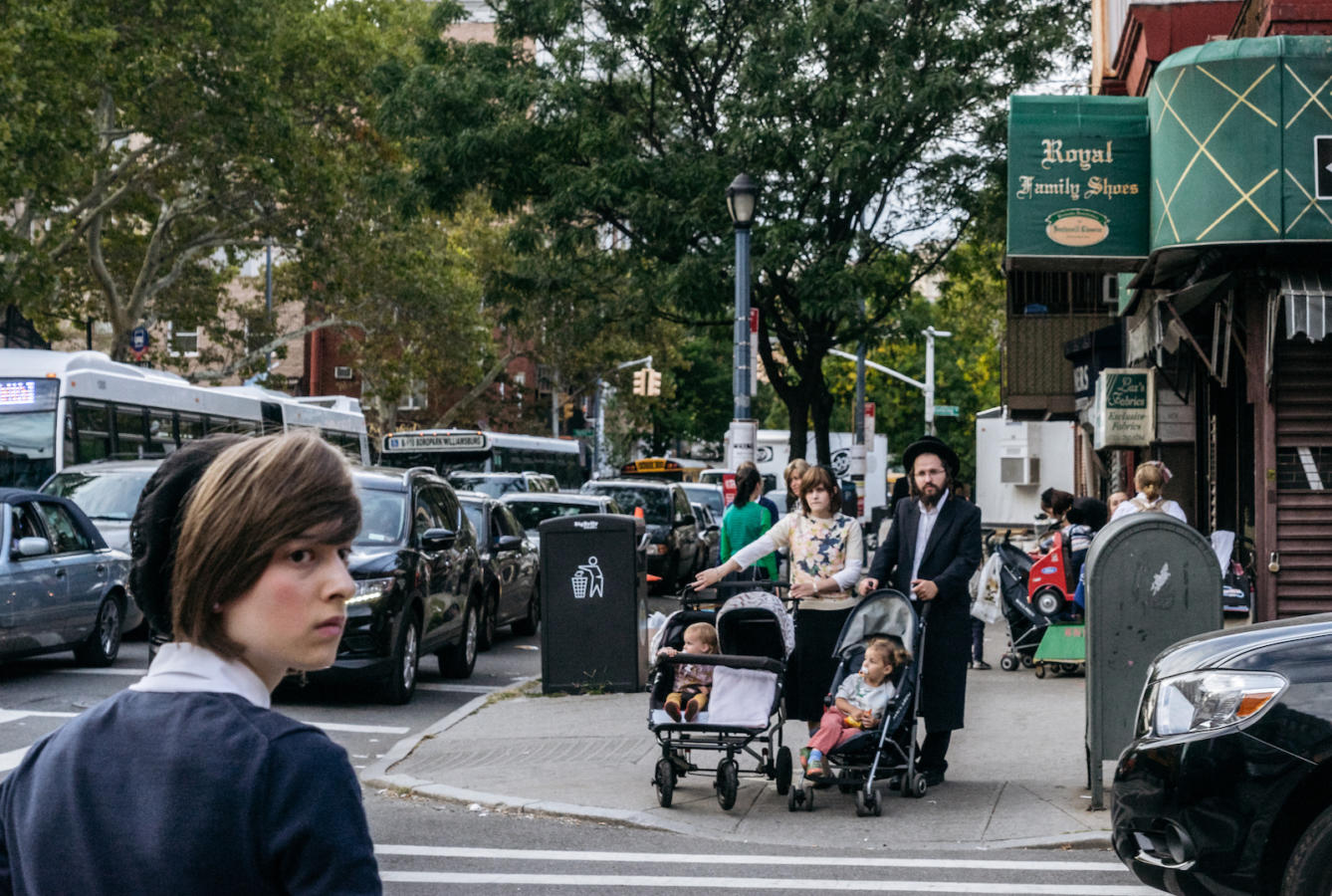
In the United States today, the Hasidic male, in black coat, black hat, tzitzit fringes, beard and sidecurls, is easily recognized today as a symbol of ultra-Orthodox Judaism and Talmud scholarship. Visually, he summarizes an ongoing commitment to religious practices once confined to the Jewish shtetls of Eastern Europe. His yeshiva training and devotion to daily piety make him a “holy man” in our secular society, although some more assimilated Jews find the Hasidic life-style anachronistic or embarrassing. Far less visible is the contemporary Hasidic woman, though no less devout. While her secular education is limited to high school and perhaps some vocational training, she is often a family breadwinner, working outside the home—and this is considered perfectly appropriate, if such work frees a scholarly husband for study or pays for children’s yeshiva tuition. Economic roles for Hasidic women include shopkeeping, teaching in girls’ religious schools, secretarial and computer jobs, and work with a specific Jewish purpose: for instance, matchmaking, and catering simhas (weddings and other celebrations).
With your help, My Jewish Learning can provide endless opportunities for learning, connection and discovery.
A Separate Society
Outside their own communities, Hasidic women are not as identifiable as their male counterparts. Their dress is modest, one truly distinguishing feature being the sheytl (wig) or tikhel (scarf) worn by all married women. Indeed, in styled wigs some Hasidic women look far more glamorous than their assimilated Jewish counterparts. (Consequently, while all ultra-Orthodox women cover their hair, unique to Hasidim is the practice among some women to wear a small scarf on top of the wig, to prevent the wig from itself becoming a possible breach of modesty.) But the laws of tzniut (modesty) are strictly observed, including monthly visits to the mikveh (the ritual immersion bath required after menstruation). Hasidic customs of modesty also prohibit mixed social events, mixed swimming at summer vacation retreats, coeducation, or women performing in front of men. A strong women’s culture results from such constant segregation by gender, and in the Lubavitcher movement, women have published articulate explanations of their roles in the separate women’s sphere.
Most Hasidic communities are in fact closed to outsiders—meaning that even other Jews cannot join the specific sect if they were not born into its lineage. This clannishness has been a public relations nightmare for some groups. In the mid-1990s, several outstanding court challenges by the Satmar Hasidic communities of Monsey and Kiryas Joel in upstate New York called for greater religious autonomy and separation from outside control. One Hasidic sect, however—the Lubavitcher movement, also known as Chabad—has gained enormous power and visibility by deliberately recruiting assimilated, nonobservant Jews to its ranks. Here, Hasidic women have been highly influential as educated, multilingual outreach activists, speakers, and writers.
Opportunities Within the Lubavitcher Movement
Based in Crown Heights, supported by the late Rebbe Menachem M. Schneerson (1902–1994), Lubavitcher women in America have enjoyed fantastic gains in educational and work opportunities. As activists, they represent the face of Hasidic women to other Jews, undertaking campaigns to popularize laws incumbent upon observant Jewish women (such as Sabbath candle-lighting and laws surrounding menstruation). From the moment he assumed leadership in 1950, the Lubavitcher Rebbe brought radical change to a movement that had always been symbolized by male activists. Within one eight-year period — 1951 to 1959 — the rebbe and his assistants approved the founding of a girls’ school system, an organization for all Lubavitcher women (Neshei Ubnos Chabad), two community publications by and for women (Di yiddishe heym and the Neshei Chabad Newsletter), and annual conventions for Lubavitcher women activists from all over North America. These institutions grew to provide a vast range of roles for women hungry for intellectual and religious challenge. By the early 1970s, when feminist criticism of ultra-Orthodox Judaism’s role for women placed the Lubavitcher movement on the defensive, a spectrum of skilled women writers were ready to answer in kind. A variety of books on the Hasidic woman’s role and belief system appeared to confront feminist calls for change. These texts included The Modern Jewish Woman and AURA: A Reader on Jewish Womanhood, both prepared by the Lubavitch Women’s Organization.
As outreach missionaries, or shluhos, Lubavitcher women as well as men travel to remote locations or to turbulent college campuses—wherever Jews live—providing, through what is known as the “Chabad House,” a lively forum for dialogue and Jewish learning. This aggressive interaction has attracted many young and adult Jews to become Lubavitcher followers. The close-knit Lubavitcher community holds considerable appeal for displaced women in postmodern society, and several books in the 1980s and 1990s explored this appeal. Lis Harris’s Holy Days, Debra Kaufman’s Rachel’s Daughters, and Lynn Davidman’s Tradition in a Rootless World are examples of feminist investigators’ growing interest in Ba’alot Teshuvah (Jewish women who have embraced ultra-Orthodoxy). Because Harris, Kaufman, and Davidman let Hasidic women speak for themselves, the reading public met many a strong-minded Lubavitcher activist, which helped to challenge misconceptions about Hasidic practices.
Into the 21st Century
For insight into Lubavitcher women’s concerns, there is no substitute for the quarterly Yiddish/English journal Di Yiddishe Heim, a Lubavitch publication which offers a mixture of Jewish history and legal interpretations, humorous anecdotes about Hasidic family life, and articles on developments in the Lubavitcher girls’ school system (Bais Rivkah). Moreover, most cities in the United States now feature a Chabad House where interested Jews may attend introductory talks or workshops on women’s role in Hasidic Judaism. While other Hasidic sects scorn the Lubavitchers as opportunistic or too willing to compromise on issues of modernity, the Lubavitch movement has enabled Hasidic women to study, advocate, and publish—in short, to gain an American voice. Other publications that serve modern Orthodox and ultra-Orthodox women include Mishpacha’s Family First, Chabad magazine, and Binah; the chief distinction for meeting strict Hasidic standards is the absence of any photograph of a woman. This level of tznius, or modesty, limits the imagery of female role models; one effort to create an Orthodox fashion magazine (Hadar) lasted only two years.
In contrast, the advent of Internet technology brought more of the contemporary world into the Hasidic home; most Hasidim use cell phones, and thus secular information is literally at hand. The intrusion of the modern world serves both as temptation to modernize and is a fresh medium for transmitting Hasidic literature, podcasts, and rabbinical updates to Hasidic mores and standards, so that even cyberspace can be used to advocate against secularization and change. In “The Instagram Influencers of Crown Heights” (2019), author Esther Werdiger noted that for Lubavitchers, “Rebbe Schneerson taught his followers that the Chabad movement can grow in numbers if they use technology to reach out to non-Orthodox Jews.” Permitted social media includes Jewish Women Empowered, Instagram, and kosher food blogs; today, the Lubavitcher girls’ high school Beth Rivkah requires its socially connected students to leave cell phones at the door for the school day — a practice shared with many secular, public high schools around the country.
Beyond the world of Hasidism, cyberspace is a double-edged sword, breaking down the isolation between women and empowering the voices of women whose religious communities require them to remain in the private sphere of the home. However, cyberspace is also a site for neo-Nazi and white power groups seeking to draw others into anti-Semitic belief and violence. Thus social media continues to make space for Hasidic followers, their Jewish feminist critics, and the enemies of Jewish survival as well. For the Hasidic community, a key advantage is their high birth rate, and in the Lubavitcher community, increasing openness to female education where it serves the needs of the community and the Rebbe’s ideals of outreach.
Reprinted from the Shalvi/Hyman Encyclopedia of Jewish Women with permission of the author and the Jewish Women’s Archive.
Hasidic
Pronounced: khah-SID-ik, Origin: Hebrew, a stream within ultra-Orthodox Judaism that grew out of an 18th-century mystical revival movement.
Talmud
Pronounced: TALL-mud, Origin: Hebrew, the set of teachings and commentaries on the Torah that form the basis for Jewish law. Comprised of the Mishnah and the Gemara, it contains the opinions of thousands of rabbis from different periods in Jewish history.
yeshiva
Pronounced: yuh-SHEE-vuh or yeh-shee-VAH, Origin: Hebrew, a traditional religious school, where students mainly study Jewish texts.