Commentary on Parashat Noach, Genesis 6:9-11:32
- God decides to cause a flood that will destroy the world, sparing only Noah’s family and the animals that Noah gathers together on the ark. (Genesis 6:9-8:22)
- Life starts over again after the Flood. The Noahide Commandments are listed, and God uses a rainbow to make a symbol of the first covenant. (Genesis 9:1-17)
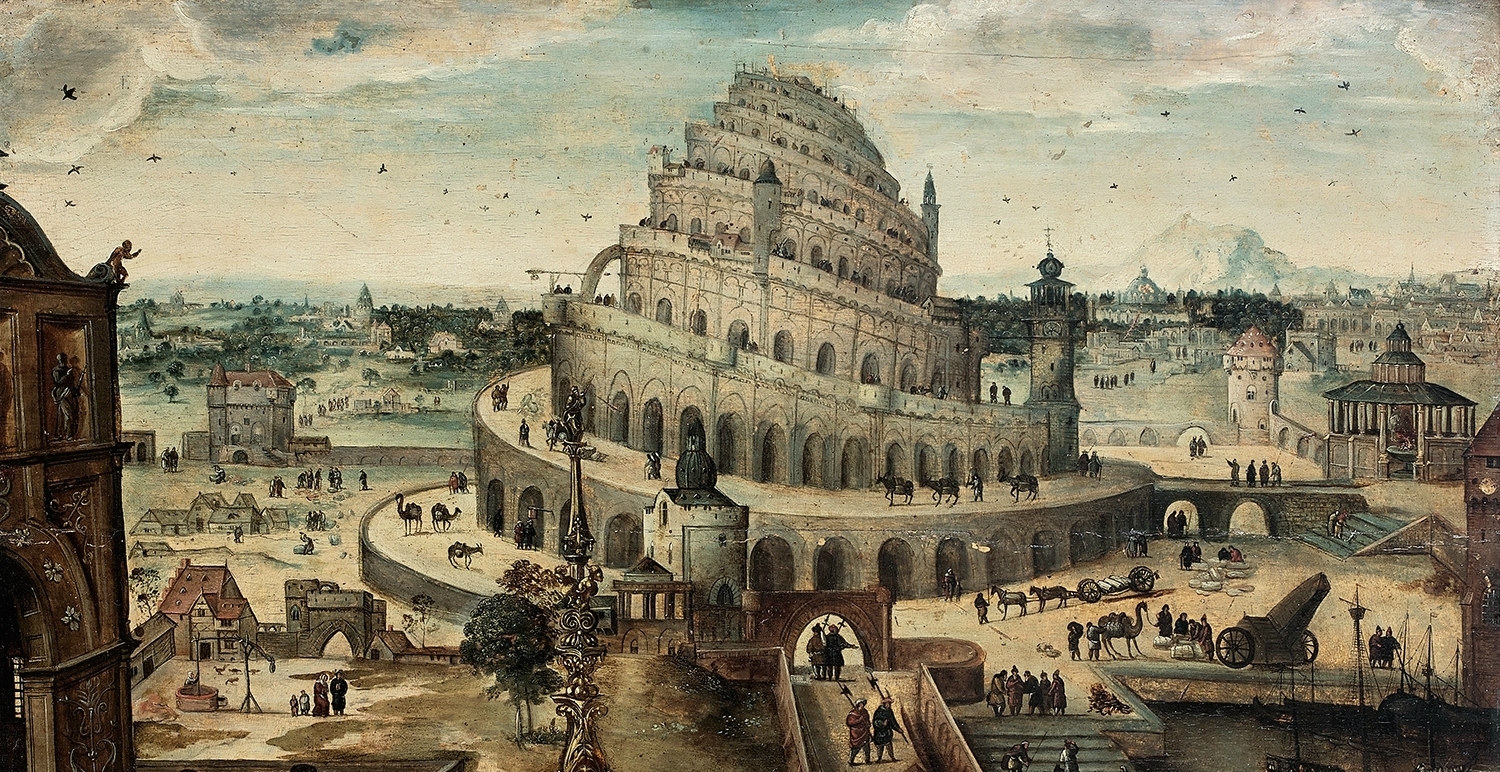
- People start to build a city and the Tower of Babel. God scatters the people and gives them different languages to speak. (Genesis 11:1-9)
- The 10 generations from Noah to Abram are listed. (Genesis 11:10-29:2)
Focal Point
(1) And the whole earth was of one language and of one speech. (2) And it came to pass, as they journeyed from the east, they found a plain in the land of Shinar; and they settled there.
(3) And they said one to another, “Come, let us make bricks and burn them thoroughly.” And they had brick for stone, and bitumen had they for mortar. (4) And they said, “Come, let us build us a city and a tower whose top may reach to heaven; and let us make us a name, lest we be scattered all over the earth.”
(5) And Adonai came down to look at the city and tower that man had built. (6) And Adonai said, “If, as one people with one language for all, this is how they have begun to act, then nothing that they may propose to do will be out of their reach. (7) Come, let us go down there and confuse their language, so they shall not understand one another’s speech.”
With your help, My Jewish Learning can provide endless opportunities for learning, connection and discovery.
(8) So Adonai scattered them abroad across the face of all the earth; and they stopped building the city. (9) That is why it was called Babel, because Adonai did there confuse the speech of all the earth; and from there did Adonai scatter them over the face of the earth (Genesis 11:1-9).
Your Guide
Scholars believe that this story is an ancient myth that tells how different languages and nations began. What other themes do you see in these verses?
How could “making themselves a name” have kept them together?
Why did God choose language as a mechanism for scattering the people?
How are language, geographic displacement, and powerlessness related?
By the Way…
No one lives in this room
without confronting the whiteness of the wall
behind the poems, planks of books,
photographs of dead heroines.
Without contemplating last and late
the true nature of poetry. The drive
to connect. The dream of a common language.
—Adrienne Rich, “Origins and History of Consciousness” in The Dream of a Common Language
“Come, let us build us a city and a tower.” Many, many years were spent building the tower. It reached so great a height that it took a year to mount to the top. A brick was, therefore, more precious in the sight of the builders than a human being. If a man fell down and met his death, none took notice of it; but if a brick dropped, they wept, because it would take a year to replace it. So intent were they upon accomplishing their purpose that they would not permit a woman to interrupt her work of brick-making when the hour of travail came upon her. Moulding bricks, she gave birth to her child, and tying it round her body in a sheet, she went on moulding bricks.
— Louis Ginzberg, Legends of the Jews
The Holy One, blessed is the One, mixed up their language so that one did not understand the other. R. Abba b. Kahana interpreted: Through their own lips I will bring them low. They desired to speak to one another in the holy tongue, but they no longer possessed a common language. Thus, when one asked his neighbor for an ax, the latter brought him a spade. In his anger, the former smote him and split his skull. Then every man took his sword, and they fought against one another. Half of the world fell by the sword. [As for the rest], “Adonai scattered them abroad from thence upon the face of all the earth” (Genesis 11:8).
— Genesis Rabbah 37
We disagree with each other on matters of moral importance–matters like abortion, nuclear weapons, the treatment of dying patients, and the distribution of wealth–and these disagreements can be painful. At times, failure to resolve them rationally leads to bloodshed. We, therefore, have good reason to be concerned with obstacles to rational persuasion. Yet, all too often, we fail even to understand what others are saying to us. Our differences go deeper than mere disagreement over propositions. Their concepts strike us as foreign. We do not speak the same moral language. Our capacity to live peaceably with each other depends upon our ability to converse intelligibly and reason coherently. But this ability is weakened by the very differences that make it necessary. The more we need it, the weaker it becomes, and we need it very badly indeed.
— Jeffrey Stout, Ethics After Babel: The Languages of Morals and Their Discontents
Language promotes communication and understanding within the group, but it also accentuates the differences in traditions and beliefs between groups; it erects barriers between tribes, nations, regions, and social classes. The Tower of Babel is an archetypal symbol of the process that turns the blessing into a curse and prevents man from reaching into heaven. According to Margaret Mead, among the two million aborigines in New Guinea, 750 different languages are spoken in 750 villages, which are at permanent war with one another.
— Arthur Koestler, upon accepting the Sonning Prize at the University of Copenhagen
Your Guide
Does a “common language” mean more than just using the same words? Is there a wholeness implied in verse 1 of the text? Does Rich’s poem hint at our longing for that state?
Why did the rabbis attribute the materialism indicated by the Ginzberg quote to the builders of the tower?
We often react with frustration or anger when we cannot make ourselves understood. Can people without a common language remain together, or must they disperse?
Since the world was harmed by the building of the tower, what must happen in order for us to be able to achieve tikkun olam (“repair of the world”)? How can we achieve a common language?
Commentary
The Midrash tries to find reasons why the people building the Tower of Babel were at fault, so that God had to confound their language and separate them. Certainly we know from our own experience that miscommunication and lack of communication are the cause of much discord and imbalance in the world, both personal and global. But if communication is a desirable thing, why would God take it away from humans? Perhaps the motives that informed the communication were at fault. With words we create, and the builders of the tower were creating a monument to their own arrogance.
Provided by the Union of Reform Judaism, the central body of Reform Judaism in North America.
Adonai
Pronounced: ah-doe-NYE, Origin: Hebrew, a name for God.
Midrash
Pronounced: MIDD-rash, Origin: Hebrew, the process of interpretation by which the rabbis filled in “gaps” found in the Torah.