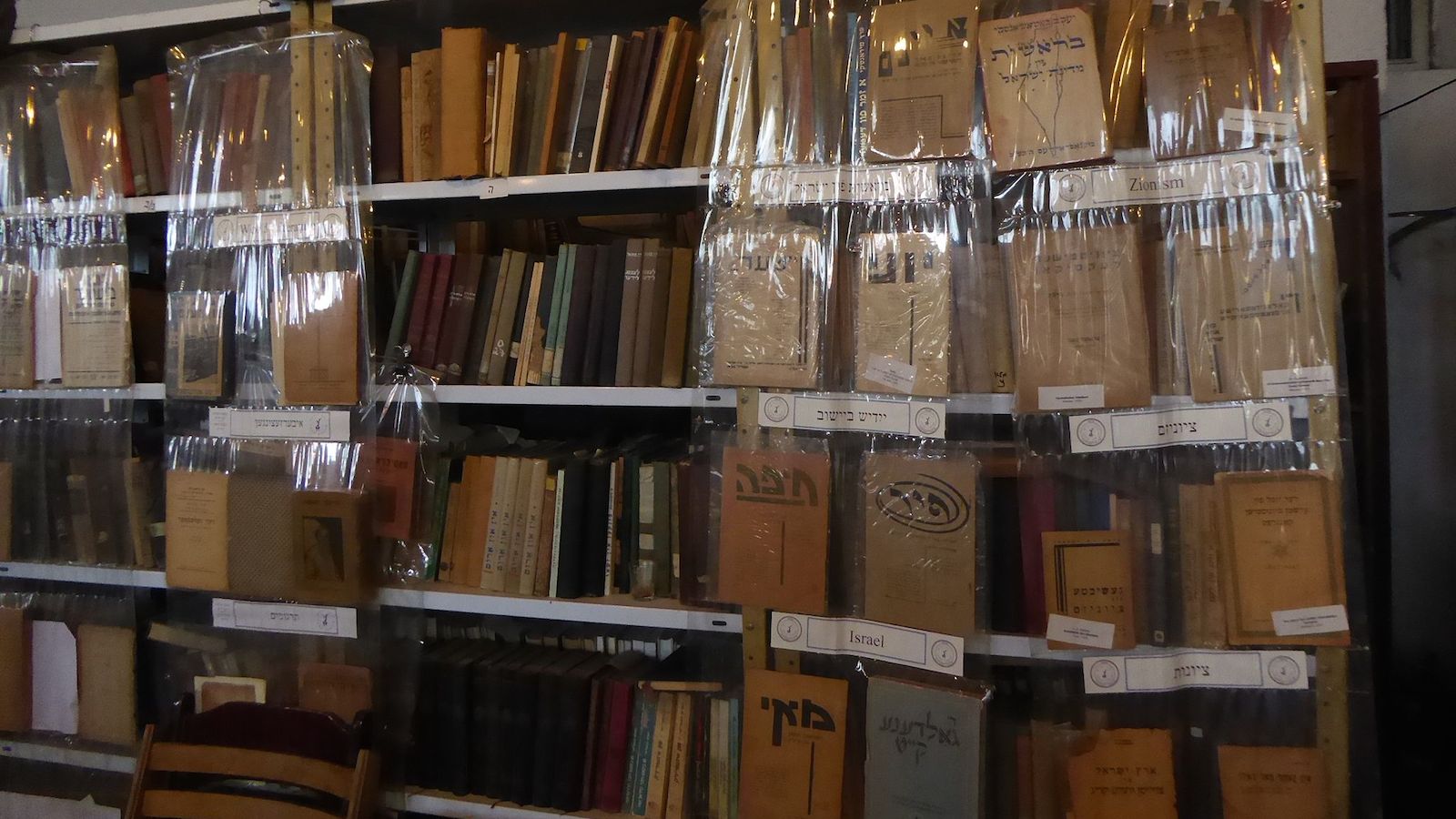
Mendele Mokher Seforim, Sholom Aleichem, and I.L. Peretz [three of the most influential Yiddish writers] laid the foundation for modern Yiddish literature — and by their deaths, during World War I, Yiddish writers had found a wide, receptive audience.
In Poland, stimulated by writers like Peretz, Warsaw became the Yiddish literary center for younger writers such as David Pinski (1872-1959), noted for his novel Dos Hoyz fun Noyakh Edon (The House of Noah Edon, 1931); Sholem Asch (1880-1957), author of such popular historical novels as Kiddush Hashem (Martyrdom, 1919) and the trilogy Farn Mabul (Before the Flood, 1921-31); the poet and short-story writer Abraham Reisen (1876-1953), author of the beautiful and moving poem “May Kemashmalon” (What Does It Tell Us); and the novelist Israel Joshua Singer (1893-1944), master of such family sagas as Di BriderAshkenazi (Brothers Ashkenazi, 1936), and Yoshe Kalb,1932.
The period between 1900 and World War I saw a continuing immigration of East European authors to America. New York City became almost as important as Warsaw as a center for Yiddish writers. Numerous Yiddish newspapers, such as the Jewish Daily Forward, published their stories and serialized their novels. The immigrant experience became fertile ground for Yiddish storytellers.Some looked back with nostalgia to the Old World; others drew on the present, creating serious or humorous sketches of immigrant characters trying to adapt to a strange, new world. Important writers from this period include: Joseph Opatoshu (1886-1954), for example, In Poylishe Velder (In Polish Woods), 1921, and Abraham Cahan (1860-1951), for example, The Rise of David Levinksy, 1917, who was editor of the Jewish Daily Forward.Israel Joshua Singer’s younger brother, Isaac Bashevis Singer, also came to New York City. He was one of the few to find an English-speaking and then worldwide audience for his work. Isaac Bashevis Singer’s success exceeded that of any contemporary Jewish writer, and he was given the Nobel Prize in 1978 for his unique expressionist and even surreal Yiddish vision.
Alternatives to America
As the turmoil leading up to World War II continued, Jews in Europe kept fleeing social upheaval and persecution. As entry into America became more difficult, many immigrated to places like South Africa, Australia and Latin America. Here too, Yiddish readers eagerly awaited new work from abroad. After the Russian Revolution (1917), the Soviet Union seemed to offer a greater freedom and hope for Jews. They had fought in the Revolution, hoping that its socialist ideals would end czarist oppression. Many Yiddish writers and poets flourished in the initial atmosphere of tolerance and experimentation.
With your help, My Jewish Learning can provide endless opportunities for learning, connection and discovery.
But as Stalinism’s deadly shadow spread, there was a resurgence of anti-Semitism, and the blossoming of Yiddish Soviet writers was doomed to elimination in the gulags and by firing squads. Notable writers, many who were executed, included Moshe Kulbak (1896-1940), for example, the novel Zelmenianier, 1931; David Bergelson (1884-1952), for example, the novel Nokh Alemen (After All), 1913; and Peretz Markish (1895-1952), for example, the novel Dor Ayn, Dor Oys (Generation In, Generation Out), 1929. The Soviet promise of a home for Yiddish literature was never realized.
The Nazi Holocaust decimated the Yiddish-speaking population Europe, along with its writers, poets, and artists. Those who were lucky escaped to America, Palestine, or other countries. The work of someYiddish writers survives this period, including those of the poet Yitzkhok Katzenelson (1886-1944) and the writer Emanuel Ringelblum (1897-1944). Both took part in the Warsaw ghetto uprising and documented their brutal experiences for posterity.
The Land of Israel
Prior to the formation of the State of Israel (1948), Palestine was not important center for Yiddish writing. Many early Zionists believed Hebrew should be the dominant language, and Yiddish was regarded with disdain, even though it was spoken widely by Ashkenazi [Eastern European] Jews. Early pioneers were drawn to the kibbutznik way of life and included among them were Yiddish writers emigrating from Europe. These included writers and poets such as Barahman Lev (1910-1970), Yoel Mastboin (1884-1957), Abraham Rives (1900-1962), and the woman poet Rikudah Potash (1906-1965).
After statehood greater efforts were made to recognize Yiddish with centers of study and publications. Much of the Yiddish writing in Israel after the Holocaust centered on stories, novels, and memoirs recounting the hardships of survival in Europe. Yiddish scholarly activity now concentrated mainly on Israeli universities. Since 1994, the scholarly journal Khulyot (Links), featuring articles in Hebrew and Yiddish dealing with Yiddish writing and writers, has been published jointly by faculties of the Universities of Haifa and Tel Aviv.
After the Holocaust
Prior to World War II, Poland, Russia and America were centers of Yiddish writing. After the war, Poland lost 90 percent of its Jews. Russia’s anti-Semitic policies silenced most Jewish writers, and many migrated to Israel up through the breakup of the Soviet Union. Only America remained as a vital center for Yiddish literature, especially as European refugees arrived immediately after the war. Yiddish centers, like YIVO, were repositories of Yiddish culture, and Yiddish studies were introduced in some American universities. In general, however, there has been a steady decline of Yiddish writers in America, and with the death of Isaac Bashevis Singer (1991), a dominant Yiddish literary voice was lost.
Nevertheless, a young, vital, mostly American-born generation of Yiddish writers has sprung up phoenix-like in the wake of the Holocaust. The work of this group was first exhibited in 1989 in an anthology titled Vidervuks (Regrowth), published jointly by the League for Yiddish and the Yugentruf organizations.
Vidervuks: a nayer dor yidishe shraybers (Regrowth: A New Generation of Yiddish Writers) features the work of 20 young poets, short-story writers, and essayists born after the Holocaust in such diverse places as Argentina, Canada, Israel, Poland, Russia, and the United States. Among them are emerging figures in Yiddish cultural circles such as Leybl Botwinik, David E. Fishman, Paul Glasser, Itzek Gottesman, Avrom Novershtern, Leye Robinson, David G. Roskies and Gitl Schaechter-Viswanath.
The anthology was named after a Yiddish literary group called Vidervuks that appeared some 80 years ago in post-World War I Kiev. Its name symbolized a rebirth of Yiddish literary activity after the pogroms of 1917-20. If the recently reincarnated Vidervuks will live up to its promise, it will constitute a rebirth of Yiddish cultural activity in the 21st century.
Thus, though contemporary Yiddish literature is often described as a dying art, it continues to make its presence known. As the Nobel Laureate Isaac Bashevis Singer said:
Why do I write in a dying language? I like to write about ghosts. Nothing fits a ghost better than a dying language. Ghosts love Yiddish — they all speak it. I believe in resurrection and the Messiah will soon come, and millions of Yiddish-speaking corpses will rise from their graves one day and their first questions will be: “Is there any new Yiddish book to read?” (Source: “Isaac in America,” WNET Public Television, 1985, from Singer’s remarks when receiving the Nobel Prize, not found in his speech from Nobel Archives.)
Reprinted with permission from Meshuggenary: Celebrating the World of Yiddish (Simon & Schuster).
Ashkenazi
Pronounced: AHSH-ken-AH-zee, Origin: Hebrew, Jews of Central and Eastern European origin.
Moshe
Pronounced: moe-SHEH, Origin: Hebrew, Moses, whom God chooses to lead the Jews out of Egypt.