The Jewish musical of all Jewish musicals hit the screen in 1971, three years after Funny Girl [a highly anticipated musical film starring Barbra Streisand] and with the same kind of anticipation. Actually, anticipation was even greater, since the stage version of Fiddler on the Roof was a bigger hit than Funny Girl, and the curiosity about how well the screen’s Topol would measure up against the stage’s Zero Mostel developed into an American-Jewish version of “Who shot J.R.?”
A story of Jewish traditions tenaciously clung to in the face of adversity; Fiddler on the Roof, written by Joseph Stein and directed by Norman Jewison, was blessed with a versatile, enthusiastic ensemble. It also boasted a marvelous Broadway score and an old world reality found and replicated by the production crew in realistic Yugoslavian locations and filmed with shades, tones, and colors specifically chosen to resemble a Marc Chagall painting.
Casting Tevye
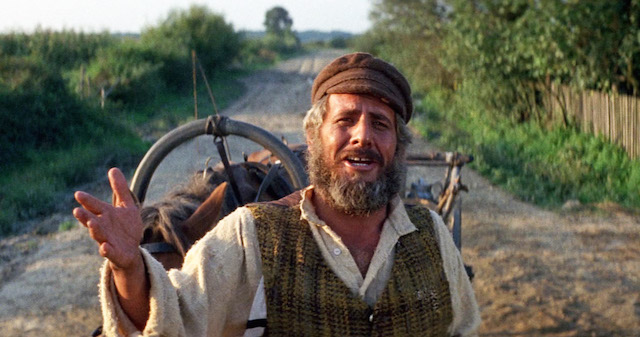
In terms of production problems, why should Fiddler on the Roof be different from any other movie musical? First, of course, there was the Tevye tribulation, and then the director dilemma. Many actors, including Mostel and Danny Thomas, lobbied hard for the part of the poor milkman with five daughters. But it was the Israeli actor Topol — who had played Tevye for many years on the London stage — who won the coveted role. Many thought his more muted approach to the character (compared with Mostel’s) would hurt the film. Topol, in turn, raised concerns that the studio’s choice for director, the non-Jewish Jewison, might not be able to interpret the emotions or characters of the story properly.
Topol and Jewison, as it turned out, were both excellent choices.
With your help, My Jewish Learning can provide endless opportunities for learning, connection and discovery.
The townsfolk of Anatevka, a Russian shtetl, or poor, tiny village, try to “scratch out a simple little tune without breaking their necks.” Tevye’s horse, though, breaks its leg, his daughters begin to break tradition –and his wife, Golde, would like to break his neck when he gives in to his daughters’ marital whims.
But Tevye is not a broken man–a poor man, yes, but not a broken one. He has faith in his faith, and everything he does, including the songs he sings, speaks to that faith. He dreams of being a rich man so that he would have more time to sit in the synagogue and pray. He talks and even argues with God, coming to some very special realizations along the way. When his eldest daughter, Tzeitel, and her beau, Motel the tailor, tell him that they have given each other a pledge to marry without using a matchmaker, Tevye suddenly realizes that they are indeed using a matchmaker–the same one used by Adam and Eve–and he takes comfort in that.
Supporting Cast
Tevye may be the story’s central character (Joseph Stein’s libretto and screenplay are based on a collection of Sholom Aleichem short stories called “Tevye and His Daughters”) but Fiddler on the Roof is peopled with a cast of likable characters played by talented pros, which gives the movie much of its charm. Leonard Frey plays the tailor with an infectious innocence, goodness, and earnestness that won him an Academy Award nomination as best supporting actor. Norma Crane is a tough and effective Golde. Yiddish stage star Molly Picon is an adorable and quirky Yente the Matchmaker.
But Tevye is the one who holds it all together more than anyone else. Stoic, warm, and wise, he is the only one who can get away with jabbing his finger at God and saying, “I’m not really complaining. After all, with your help, I’m starving to death.”
The score, by Sheldon Harnick and Jerry Bock, effectively evokes the daily struggles of these life-loving Jews. Beginning with the opening ensemble number, “Tradition,” through “Matchmaker, Matchmaker,” “Sabbath Prayer,” “To Life,” “Miracle of Miracles,” “Do You Love Me?” “Far from the Home I Love,” and others, each one seems hand-sewn to the characters to tell the story of their lives and their little village. (Thanks to the success of Fiddler on the Roof on stage and screen, every wedding band in the world knows “Sunrise, Sunset” backward and forward.) The dances by Tom Abbott, who was Jerome Robbins’s assistant on the original Broadway production, are based on the stage play’s choreography.
Directing
Jewison — whose body of work includes The Cincinnati Kid, In the Heat of the Night, and Moonstruck — is one of the most serious and insightful directors around, and as much as drama, musical comedy always benefits from insightful direction. So when Motel feels like a king for standing up to Tevye, the angle Jewison chooses, unlike any other angle in the film, almost literally shows how he feels 10 feet tall. And when Golde tells Tevye that their third daughter, Chava (Neva Small), has run away to marry the gentile Fyedka (Raymond Lovelock), the scene is set in a vast expanse of cold, barren landscape, as if all the beauty and familial comforts of their lives have been ripped mercilessly away from them. It’s a chilling scene in more ways than one.
Fiddler on the Roof was the third most successful movie musical of the 1970s, the last decade in which movie musicals were brought to life to any great degree (among them were Cabaret, Funny Lady, A Star Is Born, Grease, Hair, and The Rose). In addition to Frey’s Academy Award nomination for best supporting actor, Fiddler on the Roof also received nominations for best picture and best actor, and though it lost both (to The French Connection and Gene Hackman), it won over many audiences that might otherwise never have learned how to make a toast “to life” by shouting l’chaim! [The film did win three Academy Awards, for music, cinematography, and sound.]
Excerpted with permission from Reel Jewish (Jonathan David Publishers, Inc.).