Tag Archives: Passover

Privilege & Oppression


freedom

We recently finished celebrating Passover, a holiday where “oppression” is an ongoing theme (and freedom, of course, is our cause to celebrate). We were challenged many times—through readings, traditions and symbolism—to experience the pain of oppression and celebrate the joys that accompany freedom. One particular text comes to mind: “In every generation a person is obligated to see him/herself as if s/he, was taken out of Egypt.”

This statement encourages us to put ourselves in the shoes of people who are oppressed and to imagine what it would mean for us—personally—to be freed. Awhile back, I came across a tool that might help us better meet this challenge. I find it to be a very valuable resource when I begin to contemplate what it must be like to be oppressed, and to be free, in our society:

This chart lists various tendencies that can be found among people who are in positions of privilege and oppression. As the authors make clear, these are not personality characteristics that we can presume based on someone’s position of power: privileged or oppressed. However, it provides a framework from which we may be able to look at the behavioral tendencies that are common among people who experience privilege and oppression.  It enables us to better understand our society’s expectations of people in these different environments and the ways in which these expectations are internalized to impact the day to day lives of everyday people.

Think back to the opening of the Passover seder and our invitation to the poor to come join us for the Passover meal. There is a symbolic attempt to level the power imbalance between people who live in poverty and people who don’t. All too often, people living in poverty are forced to encounter people with behaviors that mirror those listed in the attached document. In this way, the poor in our society are often being oppressed. The idea that we open our seder tables to the poor, indicates a desire to sit alongside the poor, to get to know the poor, to better understand the poor and to treat people who are poor with dignity.

I hope that this chart provides our readers with a greater understanding of how power impacts our personal lives, the lives of fellow community members and of people around the world who are oppressed regularly. I also hope that it provides ideas on how to best fight oppression and ensure that all people, in every generation, have the experience of freedom.

What are your experiences with privilege and oppression? Do you find this chart useful?


Posted on April 10, 2013

Note: The opinions expressed here are the personal views of the author. All comments on MyJewishLearning are moderated. Any comment that is offensive or inappropriate will be removed. Privacy Policy

Thirteen Seder Virgins


On Tuesday night, I hosted a large Passover seder at my home in Jackson, Mississippi. Out of love for this Jewish dinner party, I may have opened my big mouth—then, inevitability, my door—to a few too many friends.

I realized this seder would be different as I prepared the charoset. Ever since I was old enough to wield a knife, I have been the one to slowly hand chop apples and walnuts for our family seder. It’s cathartic for me to count down the apples, add lemon juice so the apples won’t brown, and stir in the honey with my hands. After about two minutes of chopping, though, I realized my stack of apples was taller than usual; they went straight into the food processor – and this year, convenience trumped tradition, resulting in charoset with more liquid than usual.

Yikes! Why was I compromising my usual charoset consistency? Because I was too excited about sharing Passover, and ended up inviting 30 people for seder. And no, these weren’t just Jews who needed a place to go, I had 13 seder virgins! I chose to invite my non-Jewish friends and neighbors because  most of them didn’t  grow up in places with a significant Jewish population and had never been invited to help celebrate Passover. In fact, many of my guests don’t know many Jewish people besides, other than myself and other members of the ISJL staff.

seder

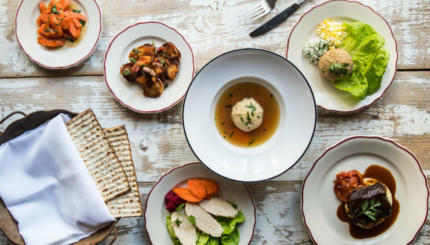
We went through the seder with some moments of quiet reflection, and some of laughter and levity. I encouraged guests to read along with the Hebrew transliteration, and my heart swelled when everyone’s voices joined together for “Go Down Moses.” We had a surprisingly successful gefilte fish tasting, sang a song about the afikomen to the tune of “Oklahoma” and answered a lot of questions about matzah.

Was it the most traditional or religious seder? No, not by any means. But I made that clear to my guests and encouraged them to take home the haggadahs to study up for next year. But even with soggier charoset,  I’m glad that I was able to provide some of my guests their first Jewish seder experience.

I enjoy having my home filled with friends and food, so it’s understandable why I got so excited about hosting a Passover seder. It’s a tradition that lends itself to bringing people into your house and sharing a meal that’s interactive, educational and delicious. I’m already planning for next year—with a tent outside!—and you are all invited.


Posted on March 29, 2013

Note: The opinions expressed here are the personal views of the author. All comments on MyJewishLearning are moderated. Any comment that is offensive or inappropriate will be removed. Privacy Policy