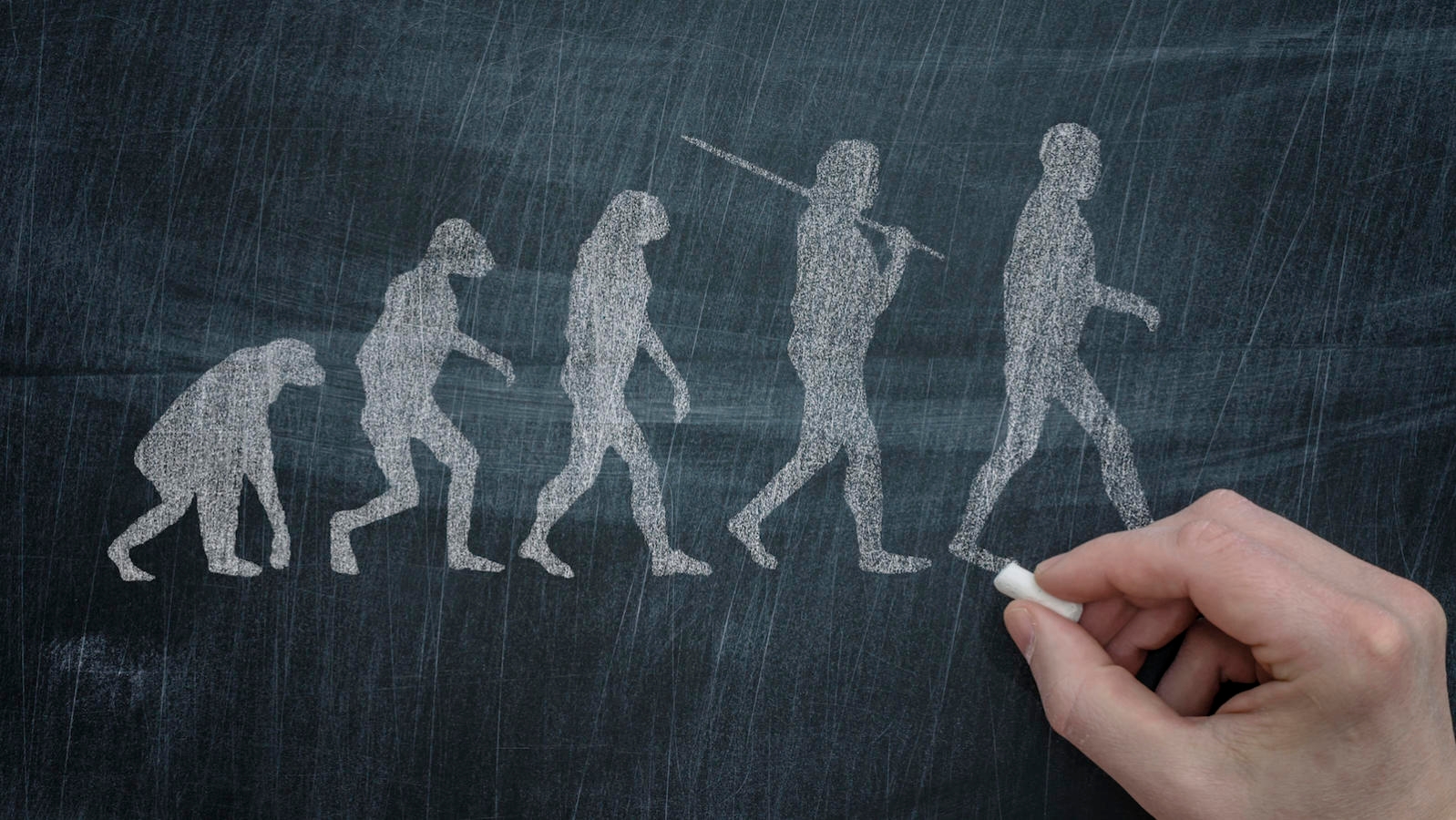
The scientific theory of evolution seems to contradict the biblical account of Creation. While the Bible claims that God created the world in six days, culminating with the creation of humanity, the theory of evolution asserts that humanity evolved over billions of years. How do Jews approach this contradiction? Like any seeming contradiction between science and Jewish tradition, there are several options.
Is It a Contradiction?
Some Jews, including many of the ultra-Orthodox, reject evolutionary theory. They see the Bible as embodying eternal truths. Thus, some of the ultra-Orthodox are unwilling to reinterpret it in order to reconcile it with a scientific theory that, in their view, may be disproved in another hundred years. Some even go so far as to ban Jewish books on evolution.
For example, in 2005, a few prominent ultra-Orthodox rabbis banned Natan Slifkin‘s books on science and the Torah, which seem to support evolutionary theory (Slifkin himself is also Orthodox). Those who ban Slifkin’s books see his arguments as challenging Jewish religious authority and undermining Jewish faith.
Other Jews reject the biblical account of creation because it contradicts evolutionary theory. They see the Bible as an ancient human document that cannot provide a helpful description of the world’s beginnings for a person living in the twentieth century. They look to modern science to explain the origin of the world and reject religious explanations.
With your help, My Jewish Learning can provide endless opportunities for learning, connection and discovery.
For example, Steven Pinker, a prominent evolutionary psychologist and Jewish atheist, rejects religious explanations of the origins of the world. He argues that the theory of natural selection best explains the origins of complex life, and no God could possibly have created a world that has so many faults in its design.
Variety of Approaches, Even Among the Orthodox
Many Jews, however, reject the either/or approach and strive to integrate the biblical account with the findings of modern science. Some Orthodox Jewish scientists read evolutionary theory into the Bible, arguing that the Bible and modern scientific theory describe the same process using different language. Most famously, Gerald Schroeder, an Israeli physicist, uses Einstein’s theory of relativity to explain how God’s six 24-hour days of creation are equivalent to fifteen billion years of scientific evolution.
Other Jewish thinkers, such as Mordecai Kaplan and Yeshayahu Leibowitz, reconcile the biblical account of creation with evolutionary theory by rejecting literal understandings of the Bible in favor of metaphorical or allegorical readings. They argue that the Bible is not meant to provide an accurate scientific description of the origins of the world. Rather, it is a spiritual account of why the world came into being and what our role is in it. These thinkers follow a long tradition of Jewish commentators who view the Bible non-literally, from rabbis of the talmudic era to Maimonides.
Some kabbalists embrace aspects of evolutionary theory as a corroboration of kabbalistic understandings of the origins of the world and its development. Rabbi Abraham Isaac Kook, the first Ashkenazic Chief Rabbi of Israel, saw evolutionary theory as support for the kabbalistic ideas of the unity of life and the progressive unfolding of natural history.
A New Layout of the Universe
Recent scientific developments have provided new opportunities for reconciling the biblical account of creation with scientific cosmogony. Most notably, the Big Bang theory, which has gained widespread acceptance in the scientific community today, asserts that the universe began at a particular point in time. This theory can support the biblical account of intentional creation at a particular time by God.
The hotly contested debate regarding teaching evolution vs. intelligent design in American schools has increased discussion of evolution within the American Jewish community. Some American Jews reject the term “intelligent design,” seeing it as part of an attempt to bring Christianity into the public schools. Yet many Jews, even those who argue against the proponents of intelligent design, still strive to see the hand of God in the origins of the world. In the wake of these debates, Jews today continue to struggle to reconcile the traditional Jewish belief in creation with the scientific theory of evolution.