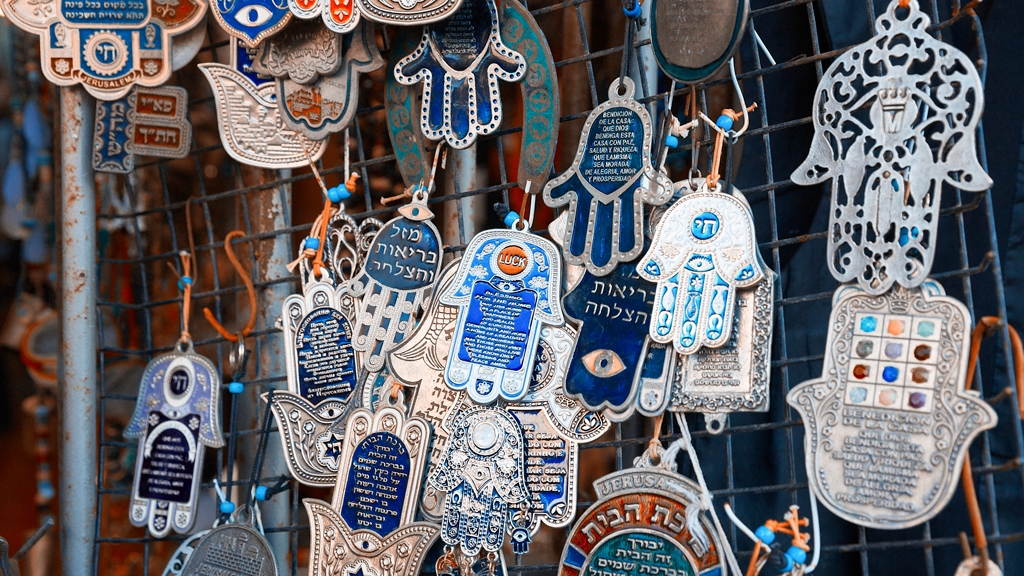
You’ve probably seen these uniquely shaped symbols on pendants worn by Jewish women or displayed in Judaica stores. And in Israel the hamsa — whether on necklaces, keychains or displayed on walls — is as ubiquitous as the Star of David.
But what is a hamsa exactly? And what makes it Jewish?
Looking to buy a hamsa? You can find a wide variety in most Judaica stores and online.
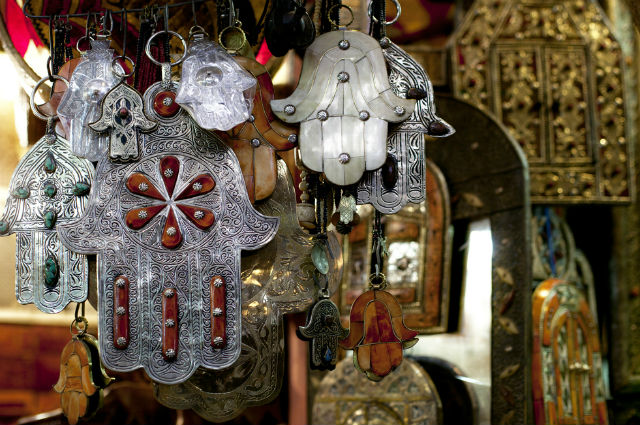
This symbol of an eye embedded in the palm of an open hand has had numerous other names throughout the ages, including the eye of Fatima, the hand of Fatima, and the hand of Miriam. The form is sometimes rendered naturally and other times symmetrically with a second thumb replacing the little finger.
With your help, My Jewish Learning can provide endless opportunities for learning, connection and discovery.
The hamsa has been variously interpreted by scholars as a Jewish, Christian, or Islamic amulet, and as a pagan fertility symbol. Yet even as the magical form remains shrouded in mystery and scholars debate nearly every aspect of its emergence, it is recognized today as a kabbalistic amulet and as an important symbol in Jewish art.
Hamsa Origins
As the references to Fatima (Mohammed’s daughter) and to Miriam (Moses’ sister) suggest, the amulet carries significance to both Jews and Muslims. One of the most prominent early appearances of the hamsa is the image of a large open hand that appears on the Puerta Judiciaria (Gate of Judgment) of the Alhambra, a 14th-century Islamic fortress in southern Spain.
The Alhambra hand of Fatima seems to draw upon the Arabic word “khamsa,” which means “five,” a number that itself is identified with fighting the Evil Eye. The Alhambra motif, as well as other Spanish and Moorish hand images, hints at the five pillars of Islam (faith, fasting, pilgrimage, prayer, and tax) in the five fingers of the hand.
According to Islamic folklore, Fatima’s hand became a symbol of faith after her husband Ali came home with a new wife one day. Fatima, who at the time had been cooking, dropped the soup ladle she had been using. Yet she was so preoccupied by the new arrival that she continued stirring using her bare hand, hardly noticing that she was burning herself.
It would not be unusual for an Islamic symbol to find its way into Sephardic Jewish culture, which flourished alongside Islam. However, amulets are somewhat problematic in Judaism because the Bible prohibits magic and divination. Still, the Talmud refers on several occasions to amulets, or kamiyot, which might come from the Hebrew meaning “to bind.” One law allows for carrying an approved amulet on the Sabbath, which suggests that amulets were common amongst Jews at some points in history. (Shabbat 53a, 61a)
Art historian Walter Leo Hildburgh also raises the possibility that the hamsa has Christian roots, and might be influenced by the Christian artistic form where Mary often carries her hands in a”fig” pose, or a configuration where the thumb is tucked under the index finger beside the middle finger.
According to University of Chicago professor Ahmed Achrati, the hamsa did not necessarily arise in a religious context. The form of the open hand appears in Paleolithic caves in France, Spain, Argentina, and Australia, including one site in Algeria that earned the name The Cave of the Hands.
In Egyptian art, the human spirit (called ka) is represented by two arms reaching upward (forming a horseshoe shape), albeit with only two fingers on each hand. The symbol of the Phoenician lunar goddess Tanit resembles a woman raising her hands, and hands also found their way into tomb decorations. Etruscans painted hands with horns on their tombs, and some Jewish burial practices featured images of hands (suggesting the priestly blessing) on stone markers of Levite graves. All of these could be considered very early precursors to the hamsa.
Jewish Beliefs About Hamsas
It is difficult to pinpoint the exact time when hamsas emerged in Jewish culture, though it is clearly a symbol of Sephardic nature. Jews might have used the hamsa to invoke the hand of God, or to counteract the Evil Eye with the eye embedded in the palm of the hand. Some hamsas contain images of fish, in accordance with Rabbi Yose son of Hanina’s statement in the Talmud that the descendants of Joseph, who received Jacob’s blessing of multiplying like fish in Genesis 48:16, are protected from the Evil Eye like fish. He explains: “the water covers the fish of the sea so the eye has no power over them (Berakhot 55b).”
Other icons besides eyes and fish have also found their way into the hamsa, including the Star of David, prayers for the traveler, the Shema, the blessing over the house, and the colors of red and blue, both of which are said to thwart the Evil Eye.
The symbol of the hand, and often of priestly hands, appears in kabbalistic manuscripts and amulets, doubling as the letter shin, the first letter of the divine name Shaddai. This mapping of the human hand over the divine name and hand might have had the effect of creating a bridge between the worshipper and God.
The Hamsa Today
The recent revival of interest in Kabbalah, in part due to the efforts of celebrities including Madonna, Brittany Spears, and Demi Moore, has brought with it a new public for kabbalah accessories, including hamsas.
Hamsas can be purchased today in Judaica shops around the world, and even through companies like Sears and Saks Fifth Avenue. Many people hang them in their houses, and it’s not uncommon to see them dangling from the rear-view mirrors of taxis and trucks. In addition to appearing on necklaces and wall hangings, hamsas can be found on mezuzahs, bracelets, earrings, bookmarks, key chains, and candlesticks.
Contemporary Jewish artists are using the hamsa form, and some like Mark Podwal are finding a large public for their work.
Hamsas still play a role in some Sephardic rituals today. During the henna ceremony, when brides are decorated in the preparation for their wedding, brides may wear a hamsa around their neck to ward off the Evil Eye.
Even as the hamsa is today affiliated with kabbalah, Israel and Judaism, it is perhaps the symbol’s mysterious origins and the superstitions surrounding it that attract the attention of celebrities and ordinary people alike.
To read this article, “What is a Hamsa?” in Spanish (leer en español), click here.
Sephardic
Pronounced: seh-FAR-dik, Origin: Hebrew, describing Jews descending from the Jews of Spain.
Talmud
Pronounced: TALL-mud, Origin: Hebrew, the set of teachings and commentaries on the Torah that form the basis for Jewish law. Comprised of the Mishnah and the Gemara, it contains the opinions of thousands of rabbis from different periods in Jewish history.