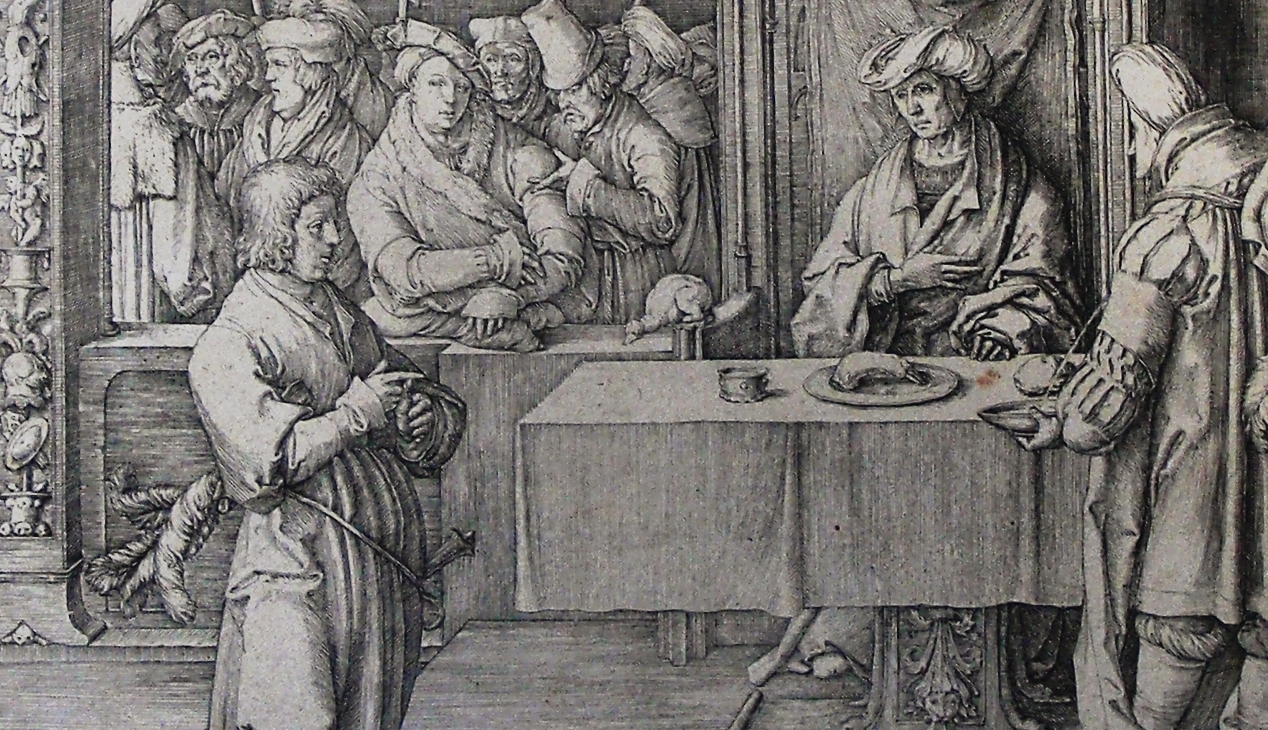
Commentary on Parashat Vayigash, Genesis 44:18-47:27
At the end of last week’s Torah portion, Joseph, now the Prime Minister of Egypt, had arranged to have a valuable cup placed in Benjamin’s saddlebags as all of his brothers head back to their father with food to stave off the famine. The cup is discovered, and it looks like Benjamin, the youngest, will have to stay in Egypt to be Joseph’s servant.
In one of the most moving stories of the entire Torah, this week’s parsha begins with Judah offering himself in place of Benjamin, so that Jacob should not be bereft of his two youngest sons. Joseph reveals himself to his brothers, and the family is reunited under his protection in Egypt. Joseph settles his entire family, including his father, all his brothers, and their families, in Egypt, in the land of Goshen.
In Focus
Then Judah approached him [Joseph] and said: “Please, my lord, let your servant speak a word in my lord’s ears, and let your anger not flare against your servant–for you are like Pharaoh!” (Genesis 44:18)
Pshat
When it appears that Benjamin will be taken away as a servant to Joseph as punishment for apparently stealing the (planted) goblet, Judah steps forward and heroically defends him, offering himself instead. He speaks humbly but eloquently, begging for mercy on Benjamin’s behalf, pleading their elderly father would be utterly heartbroken.
With your help, My Jewish Learning can provide endless opportunities for learning, connection and discovery.
Drash
Judah’s defense of Benjamin is one of the most heroic moments in the Torah; Judah seems to be selflessly sacrificing himself for the sake of his brother and father.
He has changed since the day that he and his brothers threw Joseph into the pit, many years earlier. At that time, it was Judah who suggested selling Joseph into slavery in the first place. (Genesis 37:26). He might have been saving himself the trouble of actually killing his brother (and earning a bit of money on the side), or he might have been trying to concoct a scheme to keep Joseph alive when the others wanted to spill his blood–it’s not clear what his motivations were, but he was deeply involved in the harmful scheme.
Yet Judah was not the eldest of the brothers, and it’s not immediately apparent why he was the one to step forward to defend Benjamin and offer himself in his brother’s place. (He was 4th in the order.) We can note that both Reuben and Judah personally guaranteed Benjamin’s safe return to Jacob (42:37; 43:8-10).
Furthermore, Simeon, the 2nd eldest, wasn’t there, because he was held as a hostage by Joseph when Joseph accused them of being spies; but that still leaves Reuben and Levi as being higher than Judah in the birth order, and therefore perhaps with a higher degree of leadership responsibility, at least as most ancient societies would have seen it.
So our question is still unanswered: Why was it Judah, out of all the brothers, who stepped forward to defend Benjamin?
Midrash Tanhuma, a collection of midrashic stories dating from talmudic times, offers an imaginative possibility. Noticing that the story of Judah and his daughter-in-law Tamar (Genesis 38) immediately follows the story of the presentation of Joseph’s bloody garment to Jacob (37: 31-35), the midrash posits a connection. In this midrash, it was Judah who convinced Jacob that Joseph was dead; in response, God said to Judah:
“You have no children now, and you do not know the pain of children. You have troubled your father, and caused him to mistakenly believe that his son Joseph is torn, all torn up. By your life, you will marry a woman and then bury your son, and [then you will] know the pain of children.” (Midrash Tanhuma, Vayyigash: 9; quoted in Aviva Zornberg’s, The Genesis of Desire, an extraordinary book of contemporary biblical exegesis. I have taken the midrash in a somewhat different direction than she did, but her essay is very insightful.)
On the surface, this midrash explains the whole story of Judah and Tamar, in chapter 38. The midrash connects Judah’s role in the sale of Joseph to his own experience of losing children — it is an example of midah k’neged midah, or “measure for measure.”
Yet the midrash just quoted isn’t a direct commentary on either chapter 37 or 38 — it is placed later, in the section dealing with this week’s parsha, in connection to a verse that says “[Jacob] sent Judah ahead of him to Joseph, to prepare ahead of him in Goshen . . .” when the family is about to leave the land of Israel all to be reunited in Egypt with Joseph (46:28).
In other words, our midrash seems to be about Judah’s punishment for deceiving his father, but it’s actually brought as a commentary much later in the story, after the whole family is reconciled and reunited.
So what’s going on here, and what does all this have to do with our original question: Why was it Judah who stepped forward, at great personal risk, to defend Benjamin?
I think the placement of our midrash is crucial, for if it were merely an explanation of why the story of Judah and Tamar appears where it does, it would be offering us an image of a cruel and vengeful God, who kills one child to avenge another. Because this midrash is placed later, in connection with a verse that reveals the ultimate reconciliation of Judah and his father, I think this midrash is hinting that Judah’s experience of grief and bereavement was also the sources of great spiritual growth and evolving selflessness.
Our midrash says that when Judah was willing to let his own father sit bereaved, it was because he did not know the “pain of children.” Then he married, had sons, and lost two of them–thus bringing the lesson of the “pain of children” home to him in the most real and soul-affecting way possible.
It’s not that God took away Judah’s children because of what he might have done to Jacob–that would be cruel and capricious on God’s part. Rather, the midrash tells us what made their reconciliation possible: Judah’s ability (or willingness) to empathize deeply with his father’s experience, his “knowing the pain of children.” Empathy ideally leads to compassion, and it seems Judah’s compassion was so great that he could not let his father again lose a favored younger son.
This begs a further question: why should Jacob be more bereaved at losing Benjamin than at losing Judah, since the whole point of Judah’s speech is that he will stay in Egypt as a substitute?
Whether it was because Benjamin was the youngest, or because he was a son of the beloved wife Rachel, Judah knew that Jacob had a special relationship with him, as he had once had with Joseph. (Cf. 44:30) This fact is what makes Judah’s compassion so extraordinary–not only was he able to empathize with a bereaved father, but he was even able to overcome his previous resentments to do so, perhaps even forgiving his father for loving his sons unequally.
This is the measure of Judah’s greatness: that he didn’t remain mired in his pain but grew spiritually out of it, taking tragedy and using it as the soil for empathy, compassion, forgiveness, and self-sacrifice. He was the one to step forward when the hour demanded it because he was the one who knew that to redeem himself out of his own past mistakes and accumulated grief, he had to extend himself for the redemption of others.
Provided by KOLEL–The Adult Centre for Liberal Jewish Learning, which is affiliated with Canada’s Reform movement.
parsha
Pronounced: PAR-sha or par-SHAH, Origin: Hebrew, portion, usually referring to the weekly Torah portion.