Commentary on Parashat Beha'alotcha, Numbers 8:1-12:16
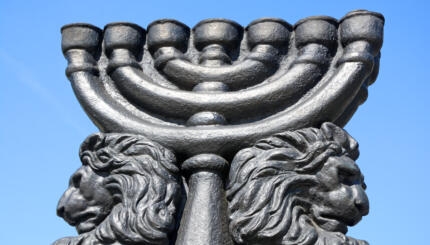
This Torah portion teaches us two very important lessons. First, we learn the proper time to light the lamps on the lamp stand of the Tabernacle. This physical act is meant to light the Tabernacle and thereby bring God’s divine light into the presence of the people. To emphasize the importance of the task, the lamp stands are made of hammered gold (Numbers 8:1-4).
Later in the portion are we taught when and how to blow the horns to summon the community, as well as the meaning behind each of the blasts. Again, to emphasize the importance of the task, the trumpets are made of precious metal — this time, hammered silver (Numbers 10:1-8).
These two responsibilities are both given importance for they both speak to the survival of the Jewish people. The acknowledgment of God’s presence has been instrumental to our survival. This is represented by the light. Likewise, our own strength and fortitude has also carried us forward. This is demonstrated by the various divisions set in motion by the blasts of the trumpets.
Perhaps it is our modern sensibilities that would view the juxtaposition of these two elements as peculiar. After all, the first is relevant to the ancient Temple cult, while the second is related to readying the Israelites for battle. But from the perspective of the Torah, both are critical for Jewish survival, and thus equally vital.
With your help, My Jewish Learning can provide endless opportunities for learning, connection and discovery.
What is it that precipitates the sounding of the trumpets? The alarm is not a siren that signals impending danger. In the Torah, it is a signal to advance against the enemy. The sounding of the trumpets summons the attention of the people and calls them to join together and advance as one.
In ancient times, the Israelites gathered to advance against an enemy. Today, the trumpet calls us to advance down a much more spiritual path. In the present day, for example, during the High Holidays, the sound of the shofar motivates the people to repentance.
Perhaps it is time to sound the shofar once again — but not because an enemy is on the horizon. Instead, we should use the resonant blasts of the trumpets to motivate the people to gather together to consider the path ahead.
While we still have enemies to face, God’s presence and our own strength (which we can bolster by allowing others to join our ranks) will ensure our survival. There is thus reason to be optimistic about the path in front of us. We can enhance the journey even more, and raise it to greater heights, however, by ensuring that, when the trumpets do sound, we do not leave anyone behind.
This commentary is provided by special arrangement with Big Tent Judaism.
shofar
Pronounced: sho-FAR or SHO-far, Origin: Hebrew, a ram’s horn that is sounded during the month of Elul, on Rosh Hashanah, and on Yom Kippur. It is mentioned numerous times in the Bible, in reference to its ceremonial use in the Temple and to its function as a signal-horn of war.
Torah
Pronunced: TORE-uh, Origin: Hebrew, the Five Books of Moses.