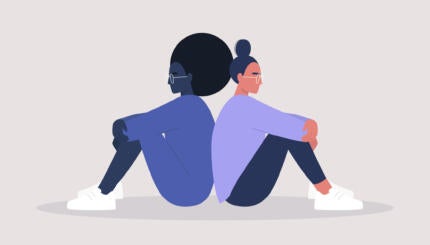
There are rooms you can walk into and immediately feel like you belong. And then there are rooms where, before anyone even says anything, you can feel yourself becoming aware of everything about you that is different.
For me, being a Jew of Color has sometimes felt like that. I have walked into Jewish spaces and noticed the small pause before someone seems to place me. Sometimes it is a question. Sometimes it is a surprise. Sometimes nobody says anything at all, but I still get the feeling that I am being asked to explain something about myself that everyone else is allowed to simply be.
Most of the time, I do not think people are trying to make me feel uncomfortable. But even harmless questions can start to feel heavy when you hear them enough. After a while, you start to notice how easily some people can walk into a space without ever having to explain why they belong there.
That is where I think identity and mental health start to overlap.
Belonging is not just being invited. It is not just someone saying, “Of course you are welcome here.” It is being able to sit down, breathe, and not wonder if people are quietly questioning your place in the room.
As a teenager, that feeling can be even more intense because you are already trying to figure out who you are. You are changing, comparing yourself to other people, and trying to understand where you fit. Feeling different for any reason can make that process so much more complicated.
For me, it can sometimes feel like different spaces understand different parts of me. In one space, people may understand my culture but not my Jewish identity. In another, people may understand Judaism but not what it feels like to move through the world as a person of color.
And I know that feeling is not only about race.
A disabled teen might walk into a room wondering whether they will actually be accommodated or whether they will have to explain what they need. A neurodivergent teen might feel like everyone else learned a social language they somehow missed. A queer teen might be quietly figuring out whether it is safe to be fully themselves. Someone from an interfaith family might wonder if they are “Jewish enough.” Someone who is less religious might feel like everyone else knows the rules except them.
The details are different, but the feeling underneath can be very similar. It is the feeling of being present, but still wondering if you fully belong.
That can be very, very lonely.
Sometimes you start editing yourself without even realizing it. You think about which parts of yourself are easy to explain and which parts might make people uncomfortable. You decide what to mention, what to leave out, what to laugh off, and what to keep to yourself. After a while, that kind of constant self-awareness gets exhausting.
I think adults who work with teens sometimes underestimate how much energy that takes. Feeling different does not always look dramatic from the outside. A teen might still smile, participate, get good grades, and seem completely fine. Meanwhile, they may be spending a huge amount of energy thinking about how they are being seen and whether it is safe to fully be themselves.
That is also why representation matters.
It is easier to believe you belong somewhere when you can actually see people like you there. Not only during a special diversity program. Not just in one photo on a website. I mean in the normal, everyday life of a community: in leadership, in stories, in classrooms, and in the people sitting around the table.
Because belonging should not feel like something you have to earn.
You should not have to prove that you are Jewish enough, disabled enough, different enough, or anything else enough to deserve support or community. Sometimes the most powerful thing a space can give a teenager is the feeling that they do not have to explain themselves before they are allowed to belong.
To me, that is what belonging really is.
It is walking into a room and, for once, not wondering if you are the exception.