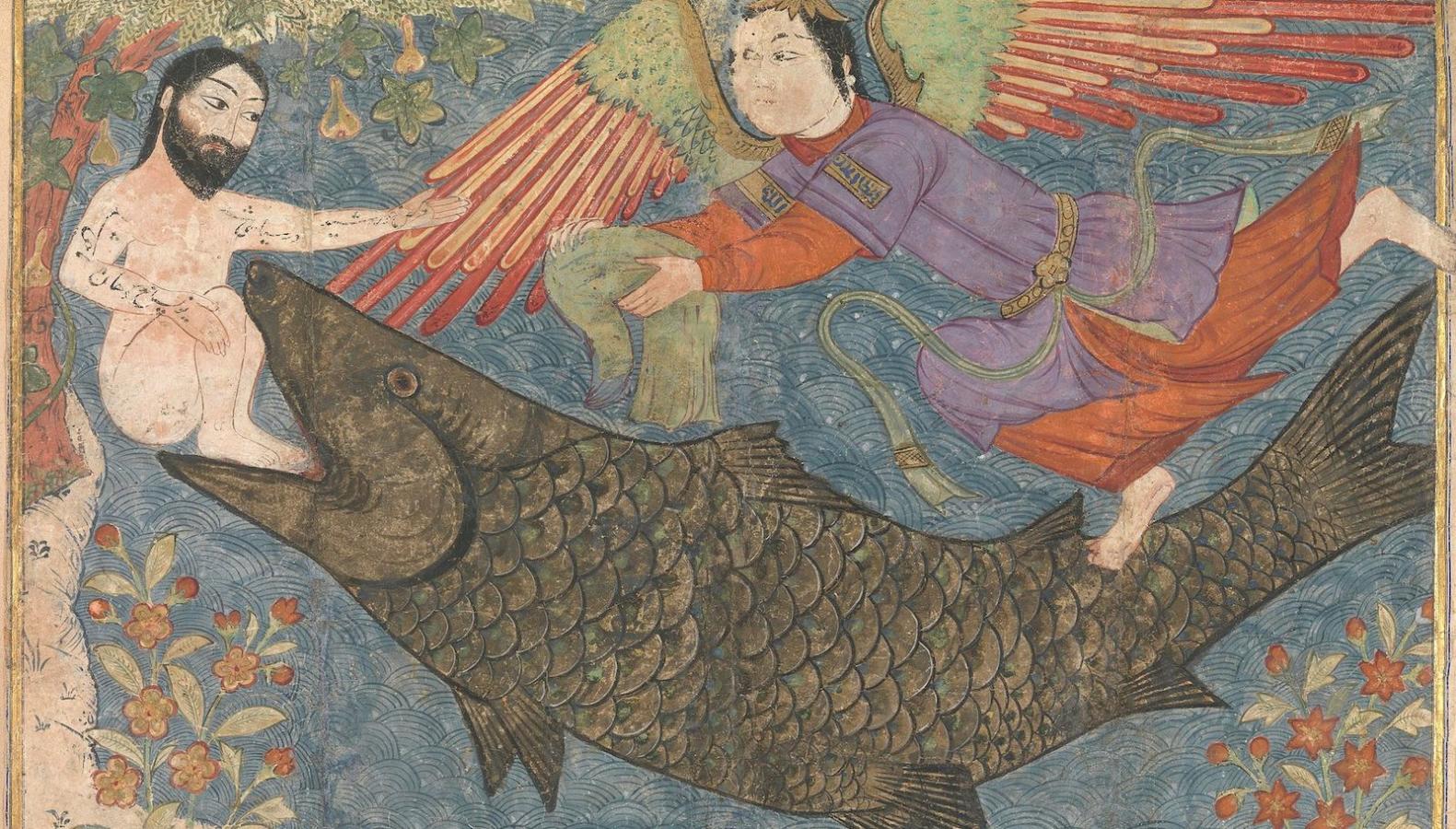
The Book of Jonah, read on Yom Kippur afternoon, serves up iconic images of the only Israelite prophet who runs from his divinely given mission. Spoiler alert: It doesn’t go well.
God tells Jonah to go preach to the people of Nineveh, who have descended into sin. Instead of complying, Jonah runs away on a ship to Tarshish (the “end of the world” in antiquity). God sends a storm to threaten the ship, so Jonah asks his boatmates to throw him overboard, choosing death over compliance with God’s mission. But God sends a fish to rescue him — so Jonah unhappily completes his mission.
Jonah’s eagerness to die rather than obey God cries out for explanation. Reams of discussion, traditional and scholarly, suggest that Jonah has a moral defect — that he is stubborn, prideful, petulant or simply too afraid of his awesome responsibility. In these interpretations, Jonah is at best a tragic hero and, at worst, an antihero whose character flaws throw into greater relief the piety of the non-Jews in the story, both the sailors who are reluctant to throw him overboard and, of course, the Ninevites who repent with marvelous alacrity.
I have always found this dim view of the prophet unsatisfactory. The text gives us no compelling reason why Jonah, an experienced prophet of Israel, should be such a hard-hearted human being. He has empathy for the crew on the ship to Tarshish. Why not also the Ninevites? Why is he anguished right up until the end of the book, when his mission (God’s plan!) ultimately succeeds? There must be a good explanation.
Curious Minds Welcome. Whatever you're wondering about Judaism, My Jewish Learning has an answer, and it's free because readers like you make it so. Give to open more doors for Jewish discovery.
People often say we read the Book of Jonah on Yom Kippur because its protagonist models repentance. But the book’s final image, of the prophet wasting away in the desert, angry that God spared the Ninevites, defies that reading.
That is because Jonah is neither recalcitrant nor relatably flawed. He is not repentant either. He has nothing to repent.
By my estimation, Jonah is a hero — a superhero, even. The key is remembering what Nineveh represents in his story. Today, perhaps, Nineveh has little resonance. But students of Jewish history will remember that Nineveh was the late military capital of the cruel Assyrian empire, a regime that gave rise to the malevolent King Nebuchadnezzar, the first tyrant who nearly destroyed Israel’s hard-won foothold in the promised land.
Second Kings 14:25 mentions Jonah (the only reference to him in the Hebrew Bible outside his own book), placing him during the reign of Jeroboam II (786–746 BCE), mere decades before the Assyrian conquest of Israel in 722 BCE. Most scholars believe Jonah’s book, however, was written several centuries later, perhaps in the late 5th or early 4th centuries BCE. This means the author would have been living through the consequences of two devastating wars on the Jewish people. (The second one, initiated by the Babylonians, having destroyed the southern kingdom and the First Temple as well.) This author placed Jonah at the brink of these cataclysmic events and put him in an impossible position. When God commanded Jonah to offer Israel’s enemy information that could save them, Jonah knew his actions would likely lead inexorably to Israel’s destruction. To analogize in terms we better understand: It’s as if an author writing in 1950 tells a story about God asking Jonah to rescue Hitler from near-certain destruction in 1932.
To his credit, Jonah’s refusal to warn Nineveh clearly gives him no pleasure. We do not sense that he is gleeful to know that Israel’s mortal enemy is on the verge of consuming itself with wanton sin. He’s above schadenfreude. On the contrary, he is sickened and overwhelmed, knowing that either the Ninevites or Israelites will die in droves. God is willing to accept the second outcome. God’s reasoning is explained directly to Jonah in the final line of the book: “And should not I care about Nineveh, that great city, in which there are more than 120,000 persons who do not yet know their right hand from their left, and many animals as well!” The Ninevites are God’s children too. God doesn’t play favorites.
But Jonah does. Faced with the worst catch-22 we can imagine for an Israelite prophet — disobey God or pave the way for the destruction of his own people — Jonah is thrown into a desperate depression. In the belly of a ship en route to Tarshish, he wills himself into a comatose slumber. When the ship encounters a storm and the captain shakes Jonah awake to demand that he pray to his God for salvation, Jonah experiences the cruel irony of that demand. His own people are also in a storm-tossed ship, and Jonah’s God has commanded him to fortify the gale that will sink it. How can he pray to that God? The grim efficiency of his choice to be thrown overboard is clear: It will save the ship. It will save Israel. It will put Jonah out of his misery.
Even the prophet’s attempt to sacrifice himself is foiled when God sends the giant fish, and Jonah reluctantly completes his mission. When the Ninevites turn instantly to theatrical remorse, Jonah dissolves into a pile of anguish because he believes, rightly, that their salvation has come at an incalculable cost to his own people. History would prove him right.
The Jewish people are named after their third patriarch, Jacob, whose divinely given name (Israel) literally means wrestle with God. His grandfather, Abraham, was the first biblical figure to stand up to God on behalf of others, warning that in wiping away the wicked cities of Sodom and Gomorrah, God might inadvertently destroy righteous people along with sinners. Moses does better than Abraham. In the wake of the golden calf fiasco, Israel’s darkest moment of communal sin, God is ready to destroy the entire people. It is Moses who gives an impassioned speech that turns God’s wrath away in the nick of time.
I would argue that Jonah is the most courageous of all. A prophet who, when handed the worst assignment imaginable, refuses to play his part. He fights God like no prophet before or since. For the most part, the tradition has shied away from fully embracing a prophet who outright rebelled against God. There are, however, traces of the appreciation I believe we are meant to have for Jonah’s extraordinary strength of character — in the 3rd-century Mekhilta of Rabbi Ishmael 12:1 and the 15th-century commentary of Don Isaac Abravanel (in his comment on Jonah 1:1).
Why doesn’t God listen to Jonah? Why does God insist that the Ninevites be given the chance to repent? The answer, I believe, can be found in the conversation between Jonah and the Yom Kippur liturgy. Once Nineveh’s repentance is complete, and their safety is assured, Jonah prays one more time to God. This time it is not the forced piety we heard from the belly of the fish, but his own true feelings: “And (Jonah) prayed to the Lord, saying: O Lord! Isn’t this just what I said when I was still in my own country? That is why I fled beforehand to Tarshish. For I know that You are a compassionate and gracious God, slow to anger, abounding in kindness …” (Jonah 4:2)
These words closely echo the Thirteen Attributes of God found in Exodus 34:6, which Jews recite over and over on Yom Kippur like a mantra: “Adonai, Adonai, El rachum v’chanun, erech apayim, v’rav chesed v’emet … Lord, Lord, compassionate and gracious God, slow to anger, abounding in kindness…” When we reach the reading of Jonah on Yom Kippur afternoon, they are by now very familiar. With Jonah, we hear them anew, this time in Jonah’s mouth where, unexpectedly, they taste bitter and ironic. Like Jonah, we know that God’s compassion and mercy don’t always spell happy endings.
The God of Jonah doesn’t play power politics, doesn’t control all aspects of human affairs. It’s not that God doesn’t care about stopping Israel’s enemies from inflicting terrible damage, but that God cares more about individual and communal repentance than the succession of empires. Maybe Jonah’s God, our God, was anguished by the brewing Assyrian invasion but could not be unmoved by the repentance of the Ninevites because, in the end, that is what mattered more: God’s children, in that moment, repenting, trying to do right.
To God, repentance is the most beautiful and important thing in the world. This is a God who glories in the beauty of the individual human soul that reflects, reexamines, realigns and repents. God wants that for the Israelites. God wants that for the Ninevites. God wants that for us, too.