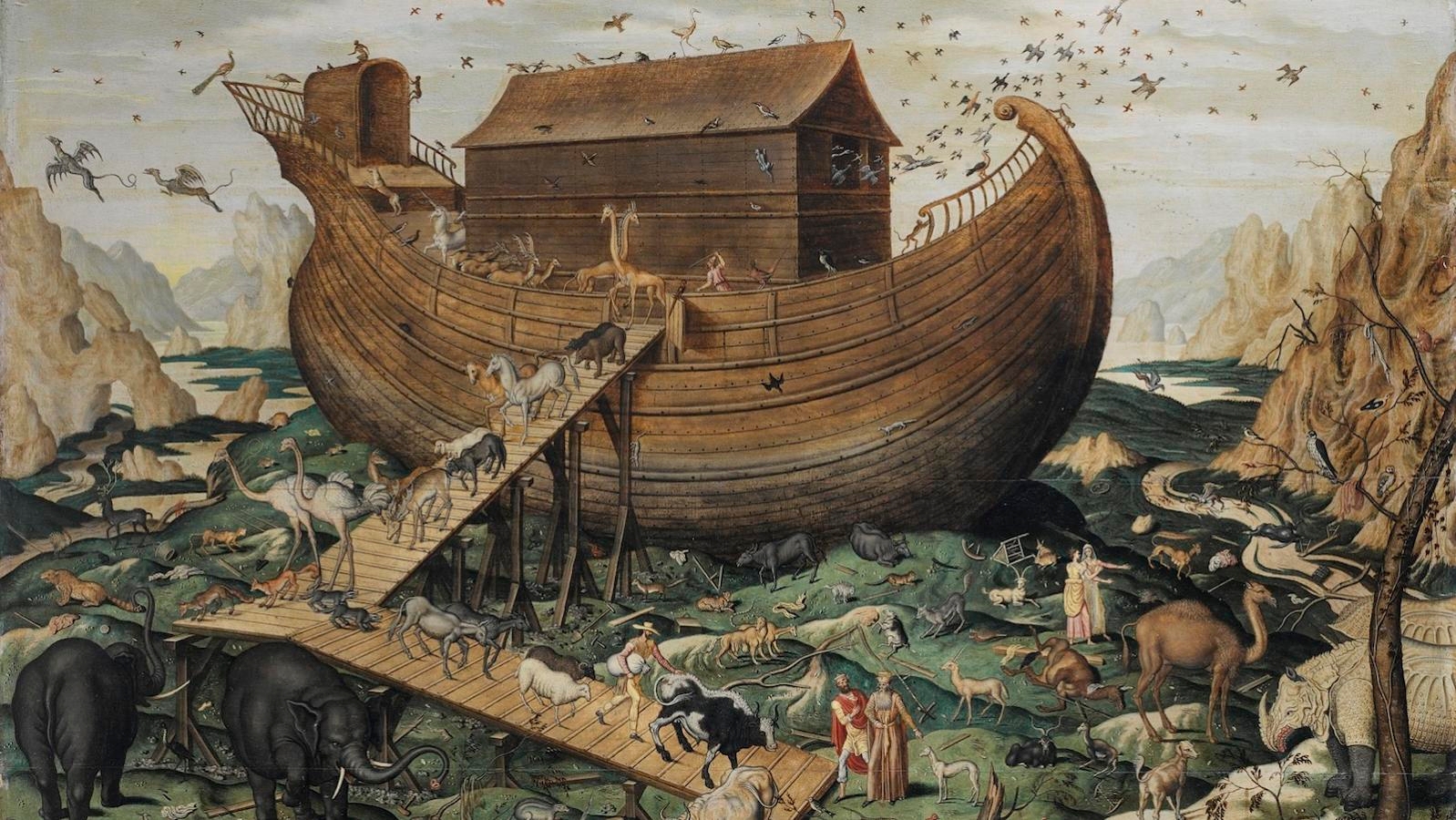
This Shabbat we read Parashat Noach, a tale of climate catastrophe with profoundly universalistic themes. This is not only because the story of a great flood is something Jews share with many cultures, with similar legends in Hindu, Greek, Chinese and American mythologies, alongside numerous Mesopotamian accounts. Nor is it only because the great waters can be seen as a symbol of the collective unconscious, a profoundly dark, mysterious deep on which the little boat of self floats rudderless and vulnerable. The image of an entire ecosystem overwhelmed is itself universalizing, a total experience affecting all life. Its would-be survivors are literally in the same boat.
In the Jewish tradition, Noah becomes a universal ancestor, only partly because he is rendered the shared father of all human life. More, he becomes the first person to enter into a covenant, or brit, with God. This covenant is more basic than the culturally specific agreements of Abraham and his kin. The covenant God makes with Noah (Genesis 9) contains a divine promise never again to destroy the earth by flood, but it does not detail the human side of the bargain. The Talmud does, however, by ascribing seven fundamental commandments to Noah and his descendants, universal laws for all humanity.
According to the Talmud (Sanhedrin 56a), these are:
Establishing courts of judgment; blessing the name of God; not worshipping the wrong things; the prohibition against forbidden sexual relations; and the prohibition of bloodshed; and the prohibition of robbery [or possibly kidnapping]; and the prohibition against eating a limb from a living animal.
Curious Minds Welcome. Whatever you're wondering about Judaism, My Jewish Learning has an answer, and it's free because readers like you make it so. Give to open more doors for Jewish discovery.
We may or may not believe everybody descends from the same survivalist pair. But we still might appreciate the suggestion that ethically we are all in the same boat, and that certain inalienable and universal human standards pertain. Prohibiting sexual violence, theft, trafficking and bloodshed seems like a good bottom line to me. The rabbis also understood the importance of orienting ourselves toward what is sacred and establishing a just legal system. And their final, memorably grotesque instruction can be understood as a general charge toward animal welfare and away from exploitation.
As for the ark itself, the fragile raft’s three stories might represent three levels of soul that animate the human form. The most basic is our nefesh, or animal life force. Ruach, the middle level, is mapped to our emotional systems, the “spirit” or “wind” that moves us. The neshama is our uppermost individual consciousness, the higher mind with its extraordinary cognitive and creative abilities.
To the Baal Shem Tov, the 18th-century sage who founded the Hasidic movement, the ark is an archetype for prayer. Noting that the Hebrew word for ark, teva, can also mean “word,” he expands upon the instruction to “install a skylight.” The ark is the word of supplication lifted up on the abyss, its window an opening through which divine light can enter our lives.
The deep waters, mythologically speaking, are home to Tiamat, tehom — sea serpent, she-dragon, mistress of the deep. This tehom, as we read last week in Genesis 1:2, seems to be a primordial element preceding creation, pre-existing light. Out of bounds, as we see in this week’s parashah, primal water can obliterate everything, with sea and sky merging back into one as the “chimneys of the sky were opened and the stoppers of the deep unplugged” (Genesis 6). Merging becomes murder as all is swept away.
But in the right balance and containment, the great waters can intimate profound peaceful recognition, and indeed there is a special blessing said upon seeing the sea. As the culmination of the famous passage featuring the lion lying down with the lamb, the prophet Isaiah gives us an image of the world perfected, with wrongdoing impossible because “the knowing of God fills the earth as the waters cover the seabed” (Isaiah 11:9).
For many of us in the Northern Hemisphere, the rainy seasons are beginning, a change we began to pray for as we concluded last month’s holy day cycle. In Judaism, water signifies benevolence, from the rains that fructify the earth to the dew, emblematic of the Creator’s eternal, enduring love for us. The waters of the mikveh offer purification and renewal, and the gates of tears, the Talmud assures us, are always open even when other gates of prayer are closed. The Sefer Yetzirah, an ancient mystical text, describes the creation of the cosmos initially through three Mother Letters, of which one is the letter mem, signifying water.
The other two letters are aleph and shin, embodying air and fire respectively. It is in the right balance between the elements that creation can occur and be sustained — as we would do well to remember. The beauty this balance produces is presented in this week’s parashah as the sign of that original covenant. The rainbow, with its exquisite balance of water molecules and fire/light, suspended together in the air, reminds all parties of the commitment to right relationship between God, humans and nature that this parashah promises.
Today, the rainbow is treasured as a symbol of inclusion, an image of unity composed of diversity. In the story of Noah, an era of corruption and violence ultimately gives way to establishing expectations for universal human conduct. Inspired by the universality of the human experience and the rainbow’s reminder that balance and beauty are possible, may we hope for the same in our days.
This essay initially appeared in My Jewish Learning’s Shabbat newsletter Recharge on October 17, 2026. To sign up to receive Recharge each week in your inbox, click here.


