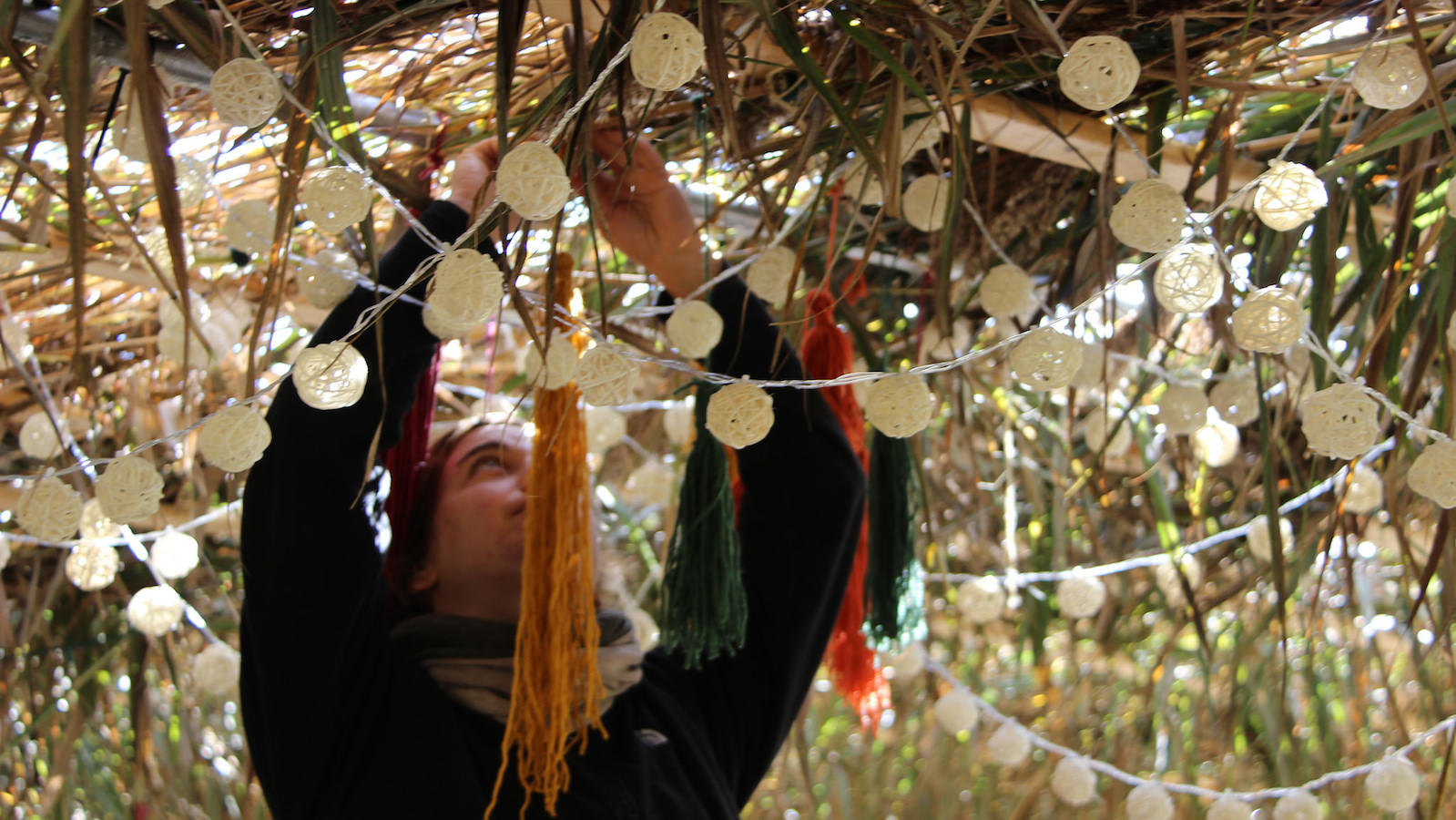
Preparations for Sukkot began this past Monday night, at what might seem like a strange moment. We had just completed the great work of the Yamim Noraim, or the Days of Awe. During the long season of repentance and return, we searched ourselves, made amends, asked for forgiveness. And then, with the final blast of the shofar still resonating in our bodies and echoing in our ears, tradition instructed us to go home and … build something?!
According to the Shulhan Arukh, a Jewish legal text, we are meant to begin constructing our sukkah the night Yom Kippur ends (motzei Yom Kippur) in order to go mitzvah l’mitzvah, from one commanded act into the next.
Hammer and nail, post to post, bamboo and leaves. On the heels of our holiest day, we begin creating a temporary structure that, beginning later in the week, will serve as a home of sorts. Look at it one way: A sukkah is a flimsy hut in the yard. Look at it another way: It is our dwelling place for the duration of the holiday. We eat there, gather there, and perhaps, for those intrepid among us, even sleep there.
The sukkah is a place of contradictions. It must be sturdy but not permanent. It must shelter us from the elements but not seal us off from nature. Its roof must provide shade while allowing light to filter through, the breeze to touch our faces and starlight to glitter overhead.
This holding of seeming opposites is built into the form of the sukkah. Like any good creative project, it offers both structure and openness. We are given guidelines: walls of a certain height and s’chach, or a roof, made from natural plant material. And yet, for a tradition often so precise in how we are meant to observe, an astonishing amount is left open to our own creative vision.
Curious Minds Welcome. Whatever you're wondering about Judaism, My Jewish Learning has an answer, and it's free because readers like you make it so. Give to open more doors for Jewish discovery.
The rabbis of the Talmud themselves seem to delight in discovering just how far the form can stretch. They imagine sukkot built atop wagons, trees and even animals. The rabbis even consider whether an elephant might serve as one of the walls. Their legal imagination gets wonderfully wild. It is as though they are asking a question that runs through the whole of Jewish life:
Given the form we have inherited, what can we make?
In this way, the sukkah offers a way of thinking about the Jewish tradition itself.
Like the sukkah, Judaism is at once something we inherit and something we must, in part, build. It has walls and openings, forms that hold us, and room within them to experiment, interpret and create. We are bequeathed a structure already partially built: texts and stories, rituals and melodies, laws and practices, memories, pain and joy carried by those who came before us. And then the tradition places the hammer and the wall hangings in our hands and says:
Make something here.
And don’t just make anything, make something beautiful.
There is a Jewish value devoted to making our ritual practices beautiful, hiddur mitzvah, and it comes to the fore this season. The sukkah becomes perhaps its most exuberant expression. We hang garlands and tapestries, fruits and paper chains, lights and artwork. There is pleasure in lining up colors that please us, hanging something whimsical simply because it makes us smile, noticing what we want to be surrounded by and giving ourselves permission to create it. We follow what delights our senses, what feels good in our hands, what evokes meaningful memories, what brings joy into the space.
We are not only asked to build a structure that works. We are encouraged to lavish care upon it, to adorn it, to let beauty and pleasure guide some of our choices. Hiddur mitzvah makes room for our own particularity — for what catches my eye, what moves you, what each of us finds beautiful. The inherited form becomes a place for personal expression, and through that expression, something softens. We come to inhabit the tradition not only because we are commanded to, but because we have helped make a place within it that reflects who we are and where we want to be.
And then, inside this impermanent dwelling, Judaism commands us to rejoice: V’samachta b’chagecha, “You shall rejoice in your festival.”
We set the table, bring out food, invite friends. We hang decorations that make us smile and watch them flutter in the breeze. We invite in ancestors and unseen guests. We sing. We smell the earth. We take the lulav and etrog, gathering pieces of the living world into our hands and shake them in every direction.
And this brings us back to where Sukkot began, on the heels of the Yamim Noraim. We have spent weeks reflecting on who we have been and who we hope to become. Now Judaism hands us the materials and says: Build something sturdy enough to hold you and porous enough to let the world enter. Make it your own. Make it beautiful.
May we build with what we’ve inherited, create with what is ours and make something beautiful enough to live inside.
This essay initially appeared in My Jewish Learning’s Shabbat newsletter Recharge on September 26, 2026. To sign up to receive Recharge each week in your inbox, click here.


