Tag Archives: Hanukkah
Chanukah/Hanukkah: So Many Ways to Celebrate
The Daf Yomi (Hebrew for “page a day”), is a program for learning Talmud. Participants study one page a day, individually or in groups, and after 7 years they have read all 2,711 pages of Talmud. Last time the cycle finished, there was a huge celebration at Met Life Stadium. Of the 90,000 people who attended, the vast majority were Orthodox Jewish men.
Despite being interested, I hesitated because I like to look at the sources through a critical historical lens—a very different approach than that used by Orthodox Daf Yomi resources. One day, I read about an Unorthodox Daf Yomi group on Facebook. After checking it out, I was inspired; I had to do it. So with the help of the Koren Steinsaltz Talmud, the JCAST Network’s Daily Daf Differently podcasts, Adam Kirsch’s weekly Tablet column on the Daf Yomi, and Rabbi Adam Chalom’s Not Your Father’s Talmud blog from a few years ago, I have read through about 60 full pages.
Through this process, I have begun to make the Talmud my own. I read the laws, discussions, and stories, and visualize how they would have applied in the Ancient Jewish world, but I can also reinterpret them to be applicable to my own life as a religiously liberal American Jew in modern times.
One of these gems is the only Talmudic mention of our current holiday, Chanukah! While the High Holidays, Purim and Passover get their own sections, Chanukah is only mentioned once, in tractate Shabbat. In it, along with many of the other laws of Hanukkah, the rabbis discuss how many menorahs each household should light:
The Rabbis taught: The law of Chanukah demands that every man should light one lamp for himself and his household. Those who seek to embellish the mitzvah have a lamp lit for every member of the household. (Shabbat 21b)
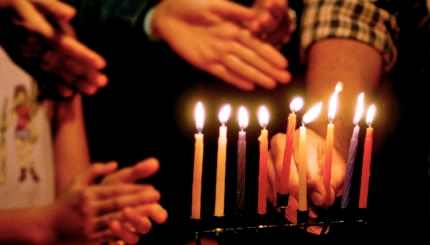
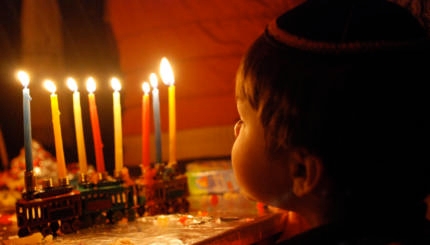
This passage echoes one of my favorite ideas of Judaism, that there is often more than one correct way to observe a tradition. I would argue further that there are many ways to lead a Jewish life, including my own non-Orthodox reading of Talmud through Daf Yomi. There is no single correct way to celebrate Hanukkah, so if you want to light one menorah for the entire household that’s great. But if you want to light one menorah for each person in the household, that’s great too. In my house growing up, we would occasionally put up decorations and occasionally give gifts. But always, each of us always lit his or her menorah, and every year we would take a family picture—including the dog—behind all of our Chanukah lights.
Many families light the candles, play dreidel, and sing maoh tzur or other songs. Other families, especially in this Southern land of fried food, revel in eating fried sufganyot and fried potato latkes. I’ve heard of some people making beignets or fried chicken! A lot of Jewish children in the South (and throughout the United States) have at least one set of non-Jewish grandparents, and some families celebrate Hanukkah and Christmas, with traditions shared to acknowledge their entire family – since family, of course, is so important to us all. However you celebrate it, and however you spell it (I used a couple different spellings in this post …), have a wonderful festival of lights!
What are some of the special ways that your family celebrates Hanukkah?
Note: The opinions expressed here are the personal views of the author. All comments on MyJewishLearning are moderated. Any comment that is offensive or inappropriate will be removed. Privacy Policy
“Shalom, Y’all”: An Arkansas Pastor’s Chanukah Wish
This blog originally appeared on Lutheran Confessions, and is re-posted here with permission from the author, Pastor Clint Schnekloth.
Although I in no way mean to imply that Lutherans and the Jewish community in Northwest Arkansas are identical, it is true some of us wear similar t-shirts (I have a t-shirt that reads “The Lord be with y’all”).
It was our honor and privilege to attend Hanukkah celebrations at Temple Shalom in Fayetteville this evening. The evening began with a blessing over the separation (Havdallah, the candle lighting to end Sabbath).
This included a nice hymn, “A good week. A week of peace/May gladness reign and joy increase.” Also the Kiddush, and blessings over the spices and the candles. We sang these standing in a large circle, then danced to the song even most non-Jewish communities know well, the Hava Nagila (let us rejoice).
Two enthusiastic Fellows from the Institute of Southern Jewish Life taught many of the traditions. The Institute sends out nine Fellows each year. They spend their year conducting Sunday school type programs in the synagogues they serve.
I love Temple Shalom’s mission statement, “Temple Shalom is located in the city of Fayetteville, nestled in the Ozark Mountains of Northwest Arkansas. We are a small, tight-knit, welcoming congregation representing a diversity of practices, and dedicated to serving as the focal point for Jewish life in our small corner of the world.”
Although past years have seen 50-60 participants in programs like the Hanukkah party, this year over 150 people were in attendance, almost all (with the exception of our Lutheran household and a few other visitors) were Jewish. Although I do not know all of the reasons for this growth, my guess is that a) it is an attractive community engaging in effective forms of outreach, and b) more Jewish families and individuals are moving to NWA.
After prayer, we lit the Hannukah candles, and we ate. I think my favorite were the latkes. I’m a huge fan of potato pancakes soaked with sour cream or apple sauce. “Latkes (Yiddish: לאַטקע) are traditionally eaten by Jews during the Hanukkah festival. The oil for cooking the latkes is symbolic of the oil from the Hanukkah story that kept the Second Temple of ancient Israel lit with a long-lasting flame that is celebrated as a miracle.”
Then there was the potluck. Lots of great hot dishes and more latkes of various shapes and flavors. We focused some of our attention on the sweets. I have this evening eaten a chocolate version of the Decalogue. Certainly evocative of Psalm 19: “The law of the Lord is perfect, sweeter than honey.”
But the best part of the party was the fellowship. Although we had to leave early for family bedtimes, we had the opportunity to spend an evening with neighbors and friends we love and deeply cherish.
We share this common story, the rededication of the Temple in Jerusalem, and Lutherans and Jews also share a common immigrant story to Arkansas. Here’s to lighting candles together, lights that fend off the darkness and give indication of our joy.
Note: The opinions expressed here are the personal views of the author. All comments on MyJewishLearning are moderated. Any comment that is offensive or inappropriate will be removed. Privacy Policy