Tag Archives: joseph

Find room for God? Or finding God in the room?


On Christmas morning, I’m reviewing the news online and I catch the Huffington Post’s summary of the Pope’s Christmas Eve Mass message.  In it, he bemoans the lack of space in our fast-paced lives for God:

“Do we have time and space for him? Do we not actually turn away God himself? We begin to do so when we have no time for him,” said the pope, wearing gold and white vestments.

“The faster we can move, the more efficient our time-saving appliances become, the less time we have. And God? The question of God never seems urgent. Our time is already completely full,” he said.

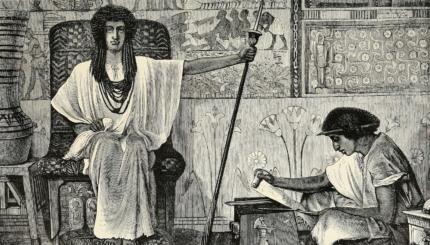
In the study sessions, the day-to-day conversations, the pastoral visits and other randomly occurring opportunities that I have with many people that touch on consciousness of the spiritual, I find a very different picture to the one that the Pope bemoans.  Just this past week, when one of my congregants gave the d’var torah after reading from parsha Vayigash, she took a survey of the congregation that night that highlighted this very issue.  At the moment in the Joseph story that Joseph reveals himself to his brothers in Egypt, he responds to their fear that he will seek vengeance on them.  He tells them that, while they may have meant their actions to do him harm, God meant it for good.  It appears that Joseph believes that every step of his path was intended by God in order to bring him to the position of influence that he now has, without which he would not be in a position to save his family from famine.  My congregant rejected this understanding of the unfolding of events.  But, in surveying the congregation, she found that most people believed that God does show up in the fabric of our everyday lives, but not in a manner that is engineering every step of our experience, implied by some of our biblical narratives.

And this is what I see in the conversations that I have – many questions and the search for a God that is part of the fabric of our lives, but not the God that is described in the ancient mind of the biblical authors.  Unlike the Pope, I do not see a wholesale rejection of God, or lives too busy to engage in the questions.  For sure, atheism is a very present strand of thought in our society.  But that is just one stage in the evolution of our understanding. What I see is the rejection of outdated God-ideas, but many are looking for part two –  the search for new language to replace those ideas that emerge from our actual, lived experiences.

Rabbi Irwin Kula makes precisely this argument in the video short he created, ‘Time for a New God.’  He seeks a new understanding of God and new conversations about God that can emerge from our most intensely felt life experiences.  Each and every moment is a potential doorway into something that gets us beyond a mundane interaction with our world and with each other.  For, he suggests, ‘the whole world is really just God in drag.’

Time after time, when I don’t start with the presentation of old God-ideas delivered by the philosophers of past centuries, but I start with the powerful experiences that we all have as part of life, and we then try to find language to express something of the ‘beyondness’ that the experience points toward but which we can’t quite encapsulate in words, I find common ground on which we can stand.  From there, it is possible to explore the possibilities of reclaiming the word ‘God’ to reflect what the inner reality of those experiences might be.  Or sometimes we’ll explore reclaiming the word ‘kedushah’ – holiness – as a doorway into noticing and elevating the importance of our most deeply felt experiences for directing, guiding, or informing our lives.  Whether I am having these conversations with adults, who may not have visited the God-idea since their bar or bat mitzvah, or I’m having these conversations with skeptical teenagers who feel empowered when they learn that they can claim a God-idea that jives with their experience of life, the result is often the same.  We don’t reach conclusions or serve up pat answers; but there is no lack of interest in exploring the questions.

And so, for many of us it is not a matter of finding room for God.  Rather, through the invitation to let go of old God-ideas that no longer work, in order to explore new doorways that can speak to the world we live in today, its more of a matter of finding God in the room.


Posted on December 26, 2012

Note: The opinions expressed here are the personal views of the author. All comments on MyJewishLearning are moderated. Any comment that is offensive or inappropriate will be removed. Privacy Policy

Rights and Submission


 Each year when I read the Joseph narratives in Genesis I discover something new. It is one of the joys for me of studying Torah.  Although I know how the story ends, I still read it as if I am looking at it for the first time and wonder how it will conclude.

Joseph and his brothers are finally reconciled after Judah, through his speech to Joseph, causes Joseph to reveal his true identity.  Genesis Rabbah 93:4 beautifully describes the rhetoric employed by Judah to finally penetrate to Joseph’ s  heart.  Judah draws out Joseph as the one who draws out the sweet water from the deep well. He enables Joseph to finally reveal his true self.

“Counsel in the heart of man is like deep water; but a man of understanding will draw it out (Proverbs 20:5). This may be compared to a deep well full of cold and excellent water, yet none could drink of it. Then came one who tied cord to cord and thread to thread, drew up its water and drank, whereupon all drew water thus and drank thereof. In the same way Judah did not cease from answering Joseph word for word until he penetrated to his very heart.”

The Shem MiShmuel quotes a passage from the Zohar (1:201b) that uses the same verse as the Midrash but reverses whom is being drawn out.

“Counsel in the heart of a man is like deep water” is exemplified in Judah at the time when he approached Joseph on behalf of Benjamin, as explained elsewhere, whereas “a man of understanding will draw it out” was exemplified in Joseph.”

For the Zohar it is Joseph who draws out Judah, despite the fact Judah makes the speech.  The Shem M’Shmuel asserts that that Joseph is teaching Judah, or perhaps better bringing to the surface, the necessity for Judah to have hachnaah  submissiveness or deference to Joseph. Judah, from whom kingship will derive, must understand while he (or his descendants) will have the power of the king, they must also have the characteristic of submissiveness. Judah is willing to be submissive to Joseph to save Benjamin. As kings his descendants will need to be submissive to God. While powerful on the one hand, they are really only the slaves/servants of God.

This Shabbat many rabbis will discuss the murders of last week. Many will call for action from our state and federal governments. The nature of the Second Amendment will be debated among friends, politicians, and in our legislatures. I think one contribution of many we can make to this urgent discussion is that while the “right to” is extraordinarily important, we must also be submissive to God or a greater good that can impose limits on our rights.


Posted on December 20, 2012

Note: The opinions expressed here are the personal views of the author. All comments on MyJewishLearning are moderated. Any comment that is offensive or inappropriate will be removed. Privacy Policy