Tag Archives: bible
Codex versus Kindle
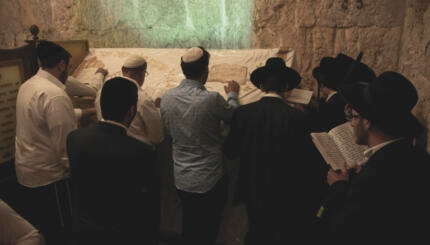
Although it fell, in retrospect, at the mid-point between the launch of the Kindle and the Kindle 2, I don’t think I had more than a vague notion of what a Kindle was on the day in the summer of 2008 when I first descended into a dark room at Israel’s national museum in Jerusalem and, standing in front of a dimly lit display case, encountered its exact opposite.
I spent much of the next four years writing the story of the object I found in the museum, a manuscript known as the Aleppo Codex – a millennium-old bundle of animal skins that is the oldest and most accurate copy of the entire Hebrew Bible. In these years I was not cut off entirely from the march of technology. I acquired an iPod, and learned to send e-mail from my cellphone. But I never purchased a Kindle or any of its cousins, nor did I fully understand what they augured.
The Aleppo Codex is a book, one of the most important on earth. I wrote a book about this book. These things seemed clear to me, but when my deadline passed and I finally looked up to find myself staring into the dead electronic eye of the Kindle Fire, I saw that the meaning of “book” had been altered and that I had just spent these years of revolution engrossed in a mirror image of the present.
To prepare the Aleppo Codex, tanners scrubbed, stretched and cut animal hides into folios that were stitched together by craftsmen. Someone scored a grid of lines onto the pages with a sharp instrument, and a scribe, Shlomo Ben-Buya’a, from the town of Tiberias on the Sea of Galilee, used iron gall ink to write the Bible’s more than 300,000 Hebrew words one by one. Its completion around 930 A.D. after years of work represented the final condensation of the Hebrew Bible from an ancient oral tradition to a codified text in black ink on parchment – a book. The codex crowned centuries of scholarship and was meant to be the perfect version of the twenty-four books that made up the Bible, a kind of physical incarnation of the heavenly text in a single manuscript.
For Jews, every letter and vowel sound in the Hebrew text is crucial – according to one tradition, the entire Torah is one long version of God’s name, which is another way of saying you do not want to get anything wrong. The codex sanctified, even fetishized, the act of reading: above and below the letters were tiny hooks, lines and circles denoting vowels, punctuation and the precise notes to which the words were to be chanted in synagogue. It was an object of nearly unimaginable value to the people who revered it.
An electronic book exists in an infinite number of copies; there is no original. The Aleppo Codex, on the other hand, existed only in its original five-hundred-page manuscript. There were no copies at all, and for this reason its physical safety was always paramount. In 1099, it was held in a Jerusalem synagogue when the First Crusade arrived under Duke Godfrey of Bouillon and Raymond, Count of Toulouse. The crusaders sacked the city, massacred its inhabitants, and seized property. According to a Muslim historian, they burned a synagogue with Jews inside, but historical records also inform us that the Christians saved hundreds of Jewish books to hold for ransom.
The Jews’ weakness in this regard was well known, and in some of the correspondences of the time it seems their concern for the stolen books was so great that it rivaled their concern for human captives. The books, each one painstakingly copied, like the codex, by hand, contained priceless and sometimes irreplaceable information. After Jerusalem fell, the Jewish community in Fustat, next to Cairo, raised money and sent 123 dinars with an emissary and instructions to “redeem the Scrolls of the Torah and to [attend to] the ransoming of the people of God, who are in the captivity of the Kingdom of Evil, may God destroy it.” The books, in that sentence, came first. Continue reading
Note: The opinions expressed here are the personal views of the author. All comments on MyJewishLearning are moderated. Any comment that is offensive or inappropriate will be removed. Privacy Policy
Chaim Sheba
In Legacy: A Genetic History of the Jewish People, Harry Ostrer wrote about a series of scientists who contributed to our contemporary understanding of Jewishness. This week, he provides a series of short vignettes that describe their contributions about what it means to be a Jew.
Chaim Sheba, a surgeon general of the Israeli army and later the director general of the Israeli Ministry of Health, was also a colorful, pioneering Israeli geneticist. Early in his career, Sheba stumbled into human genetics in the process of preparing to practice medicine in his adopted country. Born in Austria, he left for Palestine with a “still wet” medical school diploma from the University of Vienna expecting to “dry the uninhabited swamps.” Drying the swamps was a way to eliminate malaria, a disease common not only in Palestine, but throughout the coastal Mediterranean basin. While on the boat to Palestine, Sheba read a book about tropical diseases and learned that one of the major complications of malaria was blackwater fever. Typically, the “black water” urine of individuals with red blood cells disrupted by malarial parasites contained the dark-colored breakdown products of the oxygen-carrying protein, hemoglobin.
When Sheba arrived in Palestine, he learned about an unexpected springtime occurrence of blackwater fever caused by eating fava beans, a popular Mediterranean delicacy. Favism had been known in ancient Greek times with Pythagoras, Diogenes and Plutarch all warning about the dangers of eating fava beans. Eating the beans or even smelling the pollen caused a sudden illness of abdominal pains and vomiting, followed by pallor, jaundice and brown-colored urine – all resulting from the rapid breakdown of red blood cells. During the 1930s, all of the patients that Sheba observed with favism were Jewish males of Iraqi, Yemenite, or Kurdish origin. During World War II, while serving as a surgeon in the British Army, Sheba observed men who experienced severe breakdown of red blood cells resulting from ingestion of the newly developed antibiotic and anti-malarial drugs. These reactions occurred primarily among Iraqi, Turkish, Greek, Yemenite, and Kurdish Jewish soldiers, and were also common among non-Jewish Greek and Cypriot soldiers, and Italian prisoners of war. To Sheba, it was striking that Ashkenazi Jews did not share these sensitivities that were prevalent among their co-religionists.
The reason for this difference between the Ashkenazi and other Jews became apparent after the war — an inability to repair damage to red blood cells that resulted from exposure to agents that were non-toxic to the majority of the population. This inability occurred in individuals who are deficient for the enzyme, glucose-6-phosphate dehydrogenase (G6PD). As its name would suggest, G6PD normally breaks down the sugar, glucose, and, in the process, generates an antioxidant that repairs red blood cells. Although G6PD is produced and used by all of the cells of the body, only red blood cells are sensitive to the effects of oxidizing agents. The enzyme is encoded by a gene on the X chromosome and men who carry a mutant gene on their single X chromosome are susceptible to these exposures. Women who have two copies of the X chromosome are relatively resistant to this condition when one of their X chromosomes carries a mutant G6PD gene.
Over time, Sheba recognized that other genetic diseases (Tay-Sachs, Gaucher, familial Mediterranean fever) were found almost exclusively within certain Jewish groups, reflecting the unique history of those groups. He assumed that these diseases were caused by transmission of a mutant gene that occurred sometime in the distant past, and then transmitted by a group of “founders” who migrated to that site of the Jewish Diaspora. This phenomenon has come to be known as a “founder effect.” Sheba was fond of using Biblical genealogies and spoke of conditions being transmitted by the descendents of the sons of Noah or other, later Biblical characters. Thus, Sheba established the notion that these diseases serve as genetic markers for the populations in which they occurred. Although not all of the members of the population carried these mutant genes, enough do to recognize a shared genetic legacy.
Note: The opinions expressed here are the personal views of the author. All comments on MyJewishLearning are moderated. Any comment that is offensive or inappropriate will be removed. Privacy Policy