Tag Archives: Joseph
Parashat Vayechi: Uncovering Joseph’s Bones
Jews read sections of the Torah each week, and these sections, known as parshiyot, inspire endless examination year after year. Each week we will bring you regular essays examining these portions from a queer perspective, drawn from the book Torah Queeries: Weekly Commentaries on the Hebrew Bible and the Torah Queeries online collection. This week, Rabbi Jill Hammer takes comfort in the promise of eventual redemption in Joseph’s bones.

Creative Commons/Dan Diffendale
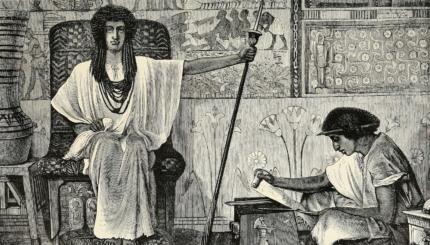
Joseph is a popular biblical character to “queer” — because rabbinic midrash claims he curls his hair, paints his eyes, and is as beautiful as his mother, Rachel (Genesis Rabbah 24), and also because he is one of the rare biblical men known for not sleeping with a woman (the lovely wife of Potiphar, who attempts to seduce him). But it’s not the living Joseph I want to queer — it’s the dead Joseph. Joseph’s bones, to be exact.
At the end of Parashat Vayechi, the very end of Genesis, Joseph lies dying. He has moved his entire family to Egypt to save them from famine, and he has rescued the whole land from hunger. Though his father, Jacob, was buried in Canaan, Joseph will be buried in Egypt. He is, after all, an Egyptian vizier. However, Joseph commands his family to take his bones with them when they eventually leave Egypt and return to the land of Israel: “When God has remembered you, you shall raise up my bones from this place.” (Gen. 50:25) Continue reading
Note: The opinions expressed here are the personal views of the author. All comments on MyJewishLearning are moderated. Any comment that is offensive or inappropriate will be removed. Privacy Policy
Joseph: Liberation of a Soul
Jews read sections of the Torah each week, and these sections, known as parshiyot, inspire endless examination year after year. Each week we will bring you regular essays examining these portions from a queer perspective, drawn from the book Torah Queeries: Weekly Commentaries on the Hebrew Bible and the Torah Queeries online collection. This week, Mijael Vera considers what the Torah’s careful documentation of Joseph’s unusual wardrobe might reveal.

Creative Common/Heather Quintal
In this week’s portion, we return once again to the story of Joseph – a story in which the connecting thread shows that whatever is normally deemed absurd comes to happen and in which literal and symbolic boundaries are repeatedly crossed. The servant (Joseph) becomes master, and the master (Pharoah) bows down to the servant. But it is in the psychological realm that boundary-crossing is most significant, for it is through a deep psychological analysis of Joseph that we come to truly understand him. Continue reading
Note: The opinions expressed here are the personal views of the author. All comments on MyJewishLearning are moderated. Any comment that is offensive or inappropriate will be removed. Privacy Policy
Parashat Miketz: The Bumpy Road to High-Drama Holiness
Jews read sections of the Torah each week, and these sections, known as parshiyot, inspire endless examination year after year. Each week we will bring you regular essays examining these portions from a queer perspective, drawn from the book Torah Queeries: Weekly Commentaries on the Hebrew Bible and the Torah Queeries online collection. This week, Maggid Jhos Singer looks at Joseph’s reunification with his brothers as an example of the profound messiness of the Jewish concept of holiness.

Creative Commons / Purple Slog
While waiting on the schoolyard the other day for my kids to get out of their classrooms, I was chatting with a little clutch of fellow parents, none of them Jewish, when the issue of my working as a Jewish Spiritualist entered the conversation. One of the parents said something like, “It must be nice being so, well, you know, holy, you know, so spiritual and everything, you must feel really, uh, so peaceful.”
I could feel my face take on a look of confusion and was aware that my head had slowly tilted, dog-like, to one side. I wanted to say, “Are you on crack?!” But, being so spiritually evolved, I managed to just grunt a little and then, mercifully, the bell rang and all chaos erupted in the form of children streaming away from their day of state-imposed confinement, effectively ending the conversation. Continue reading
Note: The opinions expressed here are the personal views of the author. All comments on MyJewishLearning are moderated. Any comment that is offensive or inappropriate will be removed. Privacy Policy